
CASHEW NUT SHELL OIL

Toasted vs Raw Desiccated Coconut is an important comparison for food manufacturers, importers, and product developers selecting coconut ingredients for bakery, confectionery, cereals, snack mixes, and ready-to-eat products. Although both products are made from mature coconut kernel, additional roasting can significantly change the ingredient’s flavor, color, texture, and storage stability.
In commercial discussions, “raw desiccated coconut” usually refers to regular or untoasted desiccated coconut. It should not be interpreted as completely unheated coconut. Desiccated coconut is a processed product made by preparing, comminuting, drying, cooling, and grading coconut kernel. According to Codex, the product is obtained through processing steps that include de-husking, peeling, milling, drying, and sifting.
Choosing between toasted and untoasted coconut therefore requires more than comparing taste. Buyers should consider the desired sensory profile, roasting level, particle size, moisture, fat quality, packaging system, and intended shelf life.
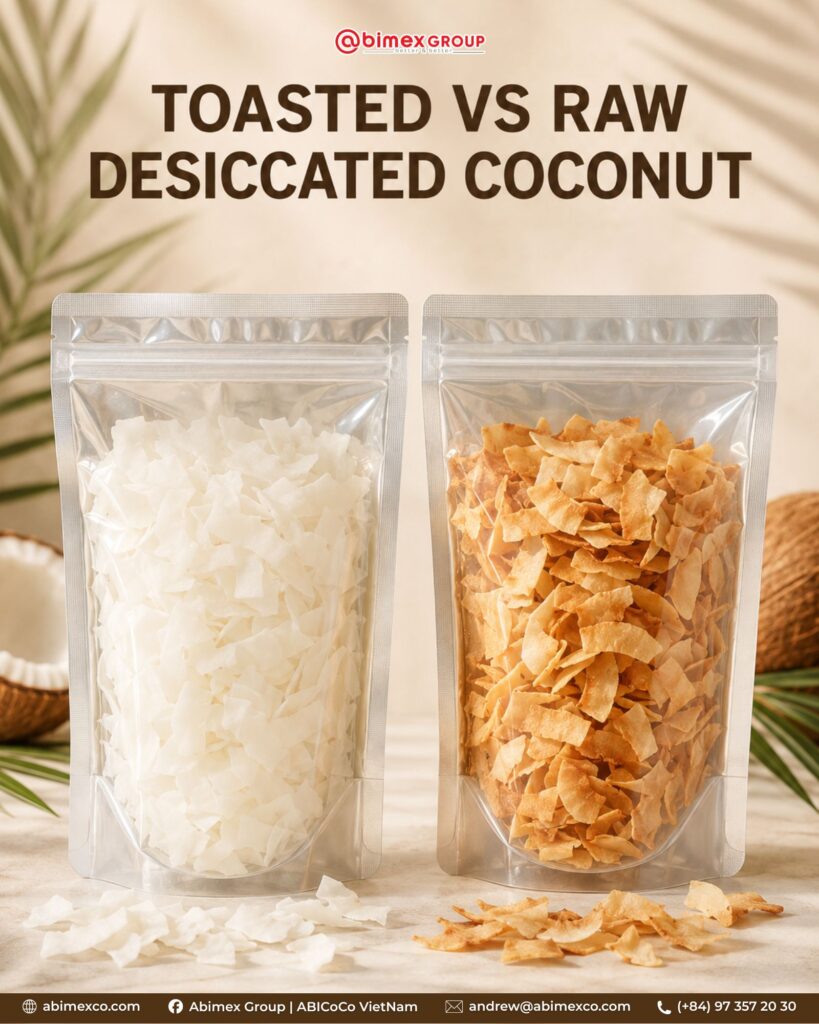
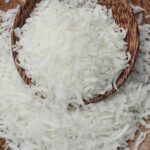
Untoasted desiccated coconut is produced from the white kernel of mature coconuts. The kernel is separated from the shell, pared to remove the brown testa when a white product is required, washed, cut or comminuted, hygienically treated, dried, cooled, graded, and packed.
Although the product is often described commercially as “raw,” it has normally undergone heat during hygienic treatment and drying. For technical documents and purchasing specifications, “untoasted desiccated coconut” is therefore the clearer term.
The finished ingredient usually has a white to creamy-white appearance with a mild, clean coconut flavor. It is commonly supplied in Fine and Medium grades, as well as special cuts such as Flakes and Chips. Fat content may also vary depending on whether the product is high-fat, medium-fat, or low-fat.
Untoasted coconut works well when manufacturers want a natural coconut character without a strong roasted note. Typical applications include bakery fillings, confectionery, macaroons, cookies, chocolate coatings, dessert mixes, curry products, and coconut-based formulations.
Toasted desiccated coconut is regular dried coconut that undergoes an additional controlled heating process to develop a darker color and stronger roasted flavor.
The product may be lightly, moderately, or darkly toasted depending on the target application. However, these terms are not universally standardized. One supplier’s “medium toasted” product may be lighter or darker than another supplier’s version.
The additional heat promotes non-enzymatic browning reactions, including Maillard reactions between amino compounds and reducing sugars. Sugar degradation may also contribute to the toasted aroma and darker appearance. The exact result depends on temperature, exposure time, moisture, coconut composition, particle size, and airflow.
In the Toasted vs Raw Desiccated Coconut comparison, toasted coconut is generally chosen when the ingredient needs to provide a noticeable nutty aroma, visible golden-brown color, or crisp initial texture.
Flavor is normally the most noticeable difference between the two products.
Untoasted desiccated coconut provides a mild, creamy, and naturally sweet coconut profile. It allows other ingredients, such as chocolate, vanilla, mango, nuts, or spices, to remain prominent in the finished formulation.
Lightly toasted coconut retains much of its natural coconut character while adding gentle roasted and nutty notes. Medium toasting creates a more pronounced aroma with deeper nutty and cooked flavors. Dark toasting produces an intense roasted profile but may develop burnt or bitter notes if temperature and time are not properly controlled.
A darker product is not automatically a better-flavored product. Excessive roasting can reduce fresh coconut notes and create an unbalanced taste. Food manufacturers should therefore select the roasting level according to the complete formulation rather than evaluating the coconut as an isolated ingredient.
When assessing Toasted vs Raw Desiccated Coconut, buyers should request representative samples and conduct application trials. An approved reference sample is especially useful because descriptions such as light, medium, golden, and dark toasted can vary between suppliers.
Untoasted desiccated coconut is normally white to creamy white. This appearance is important in white confectionery, cream fillings, macaroons, coconut coatings, and products where a clean, light-colored ingredient is required.
As roasting intensity increases, the coconut may progress from pale cream to golden yellow, light brown, medium brown, and dark brown. The resulting color is influenced by:
Fine particles have a greater surface-area-to-volume ratio and may darken faster than larger flakes or chips under the same conditions. Mixed or poorly controlled particle sizes can therefore result in uneven roasting, with some pieces becoming too dark while others remain relatively pale.
For applications where coconut remains visible, buyers should include an approved color range in the specification. Color may be controlled through reference samples, calibrated photographs, or instrumental measurements such as L*, a*, and b* values.
Untoasted coconut generally provides a softer or more tender texture, although its mouthfeel depends on particle size, fat content, moisture, and the final application. Fine grades disperse readily in doughs and fillings, while larger cuts create more visible coconut pieces and a more pronounced bite.
Toasted coconut is often perceived as drier and crispier immediately after production. It is suitable for granola, trail mixes, cereal clusters, chocolate bars, snack toppings, bakery decorations, and other applications where roasted flavor and initial crunch are desirable.
However, roasting does not guarantee that the coconut will remain crispy throughout the finished product’s shelf life. Toasted pieces may absorb moisture from fillings, syrups, chocolate centers, surrounding ingredients, or humid air. This can soften the texture over time.
Consequently, the Toasted vs Raw Desiccated Coconut decision must consider the finished product’s water activity and moisture migration—not only the coconut’s condition when it leaves the supplier.
Roasting does not automatically make desiccated coconut last longer.
An additional heat treatment may lower residual moisture under some processing conditions, but its effect must be confirmed through actual testing. At the same time, heat and oxygen exposure can initiate or accelerate changes in the coconut’s fat and aroma compounds.
Desiccated coconut is a fat-containing food ingredient. During storage, quality loss may occur through oxidation, hydrolytic rancidity, moisture absorption, aroma loss, or contamination caused by poor handling. Toasted coconut may also gradually lose its desirable roasted aroma.
Shelf-life performance depends on the complete production and storage system, including:
A roasting process may reduce some microorganisms, but it should not be described as a validated microbial kill step unless the manufacturer has supporting process-validation data. Food safety must be controlled across the complete production process. The Codex hygienic code also emphasizes hygienic treatment, controlled drying, cooling before packaging, and protection against recontamination. Codex Code of Hygienic Practice for Desiccated Coconut
Therefore, the shelf life of Toasted vs Raw Desiccated Coconut should be established separately for each product, roasting level, packaging format, and storage condition. Buyers should avoid assuming that the toasted version has the same shelf life as the regular grade.
Both toasted and untoasted desiccated coconut should be stored in a cool, dry, clean, and well-ventilated location. The product should be protected from direct sunlight, excessive heat, high humidity, pests, chemicals, and strong odors.
Packaging should limit exposure to moisture and oxygen while preventing contamination and odor transfer. Appropriate barrier protection is particularly important for toasted coconut because moisture absorption may reduce crispness, while oxygen exposure may weaken roasted aroma and contribute to oxidative deterioration.
After roasting, the product must also be sufficiently cooled before packaging. Packing warm coconut may create condensation inside the package, which can adversely affect texture, quality, and storage stability.
Manufacturers using retail packs should conduct shelf-life testing in the actual final package. Results obtained from bulk bags cannot automatically be applied to small consumer packs because the materials, headspace, sealing system, and surface-area exposure may differ.
Before choosing between Toasted vs Raw Desiccated Coconut, buyers should define the following requirements:
For toasted grades, the specification should also address color uniformity, acceptable variation, maximum burnt particles, roasting level, and sensory approval standards.
Comparing products only by price can create hidden costs. An inconsistent roasting profile may affect the appearance and flavor of the final product, increase batch rejections, or require manufacturers to adjust their formulas and processing conditions.
The Toasted vs Raw Desiccated Coconut decision affects flavor, color, texture, formulation behavior, and storage performance. Untoasted coconut offers a mild natural flavor and light appearance, while toasted coconut provides stronger roasted notes, a darker color, and a crispier initial texture.
Neither type is universally better. The correct choice depends on the buyer’s application, target sensory profile, processing conditions, packaging system, and shelf-life requirements. Representative samples, agreed specifications, application testing, and suitable packaging are essential before placing a commercial order.
Abimex Group supplies Vietnamese desiccated coconut for food manufacturers, importers, distributors, and private-label businesses. Our team can discuss your required particle size, fat content, quality parameters, packaging, and end-use application.
Contact Abimex Group to request product specifications, quotations, or samples for your desiccated coconut sourcing requirements.