
CASHEW NUT SHELL OIL

Desiccated vs shredded vs flaked coconut can be confusing terminology for importers, food manufacturers, distributors, and procurement teams. One supplier may use “shredded coconut” to describe a dried coconut cut, while another may use “desiccated coconut” as the broader product category and specify shred or flake as the physical form.
This is not simply a wording issue. If a purchase order says only “shredded coconut” or “coconut flakes,” the buyer and supplier may imagine different particle sizes, shapes, moisture profiles, or product presentations.
Official definitions also illustrate why the terminology can overlap. USDA documentation describes dried or desiccated coconut as coconut meat that has been shredded, disintegrated, and dried, and notes that flaked and shredded forms are common commercial cuts. Indian food regulations (FSSAI) similarly state that desiccated coconut may be presented as powder, flakes, chips, or shreds.
For international trade, the safest approach is therefore to treat the name as the starting point—not the complete specification.
There is no universal commercial naming system that guarantees every supplier uses these terms in exactly the same way.
In some markets, “desiccated coconut” is mainly understood as finely or medium-sized dried coconut used in bakery and confectionery. In other commercial contexts, the term can cover a broader range of dried coconut cuts.
“Shredded” usually suggests longer, narrower pieces, while “flaked” often suggests broader, flatter pieces. However, these descriptions are general rather than universal specifications.
Regulatory terminology can also vary. For example, Jamaican legislation defines shredded coconut broadly as coconut kernel reduced into particles by shredding, grating, slicing, grinding, or similar processes, while desiccated coconut is defined as shredded coconut that has undergone drying.
This reinforces an important B2B lesson: product names may overlap, while the actual physical specification remains supplier-specific.
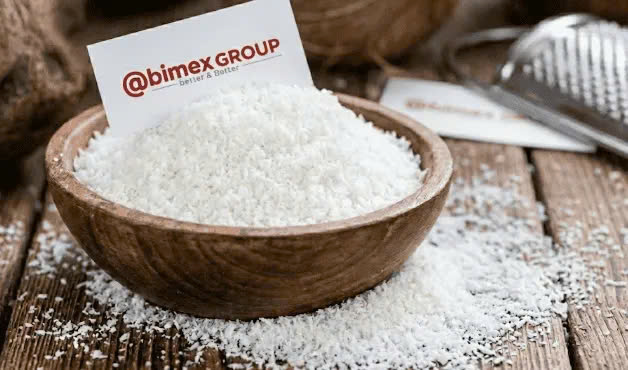
Desiccated coconut generally refers to coconut kernel that has been prepared, reduced in size, and dried.
The USDA Agricultural Thesaurus recognizes “desiccated coconut” as a dried coconut product and lists “dried coconut” as a synonym. Codex Alimentarius also maintains a dedicated international standard for desiccated coconut (CXS 177-1991), confirming that it is recognized as a defined processed coconut category.
In commercial food manufacturing, desiccated coconut may be offered in several particle sizes or cuts.
Fine grades may integrate more easily into fillings, coatings, bakery mixes, or confectionery. Medium or larger particles may provide greater texture and visual presence.
However, buyers should not assume that a supplier’s “fine,” “medium,” or other grade name automatically matches another supplier’s classification.
A grade name should ideally be supported by a technical specification or agreed reference sample.
Shredded coconut usually describes coconut that has been cut or grated into relatively narrow strands or elongated pieces.
The important point is that “shredded” describes physical form more than it describes the entire processing history.
Depending on the market, shredded coconut may be sold dried, sweetened, unsweetened, or in other product formats. USDA documentation, for example, refers to both flaked and shredded forms of dried coconut in the U.S. market.
This means a buyer should not write only “shredded coconut” on an international purchase order and assume that every supplier will interpret it identically.
Instead, the PO should clarify whether the product is dried, its intended cut characteristics, ingredient declaration, and other required specifications.
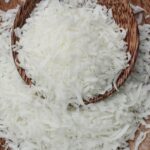
Flaked coconut generally refers to broader and flatter coconut pieces.
Compared with fine desiccated coconut, flakes may create a more visible coconut identity in products such as granola, snack mixes, bakery toppings, confectionery, or decorative applications.
However, there is no universal flake dimension that applies to every producer.
One supplier’s flake may be wider, longer, thicker, or more irregular than another supplier’s product.
Therefore, when comparing desiccated vs shredded vs flaked coconut, buyers should avoid using appearance terms as precise technical specifications unless the supplier has defined them.
Physical samples can be particularly useful when visible piece size matters to the final product.
International sourcing often involves manufacturers, traders, importers, and customers using terminology learned from different markets.
A buyer may request “coconut flakes” because that is the common retail term in their country. A producer may classify a visually similar item under a broader desiccated coconut category.
Neither side is necessarily wrong.
The problem appears when both sides assume that the same commercial word means the same specification.
For desiccated vs shredded vs flaked coconut, this can lead to differences in particle size, visual appearance, texture, mixing behavior, packaging efficiency, and application performance.
The most effective way to reduce this risk is to move from a name-based purchase order to a specification-based purchase order.
A purchase order should identify the product clearly enough that the supplier can connect it to an approved specification.
Rather than writing only “Desiccated Coconut – 10 MT,” buyers can include information such as:
The exact information will depend on the supplier, customer requirements, destination market, and product application.
The goal is not to make the PO unnecessarily complicated. It is to make sure both parties are referring to the same product.
One of the simplest ways to reduce terminology disputes is to include the supplier’s product code or agreed specification reference in the purchase order.
For example, a buyer and supplier may have already approved a particular coconut cut during sampling.
Instead of relying on a generic name such as “medium coconut,” the commercial order can reference the approved item code, specification version, and sample.
This is especially helpful when a supplier offers several similar-looking products.
When sourcing desiccated vs shredded vs flaked coconut, a unique product reference reduces the chance that a descriptive term will be interpreted differently by purchasing, production, warehouse, or export teams.
If the coconut’s physical dimensions affect the final product, buyers should consider defining particle characteristics more clearly.
For fine or medium desiccated coconut, this may involve an agreed sieve or particle-size specification.
For longer shreds or flakes, physical dimensions, visual references, or approved samples may be more practical depending on the supplier’s quality system.
The terminology and test method should be agreed between buyer and supplier.
Buyers should avoid copying a mesh number or particle-size requirement from another source without confirming that the supplier uses the same testing standard.
Fine, shredded, and flaked coconut serve different purposes.
Fine coconut may distribute more evenly in a formulation. Longer shreds may create a more noticeable texture. Broad flakes may provide stronger visual presence.
None is universally superior.
The appropriate product depends on the recipe, processing method, packaging format, target mouthfeel, appearance, and consumer positioning.
This is why desiccated vs shredded vs flaked coconut should be treated as an application decision rather than a quality ranking.
A premium product does not automatically require the largest coconut pieces, just as a fine cut does not automatically indicate higher or lower quality.
Specifications are essential, but samples can provide information that words and numbers do not fully communicate.
Before confirming a commercial order, buyers may want to evaluate the coconut in the intended application.
A sample can help demonstrate particle shape, visual distribution, mouthfeel, aroma, and how the coconut behaves during mixing, baking, coating, or other processing.
Once the product is approved, the buyer and supplier can connect the sample to the relevant written specification.
This creates a clearer purchasing reference for future orders.
The main lesson from desiccated vs shredded vs flaked coconut is that commercial names should not be treated as complete international specifications.
Different markets, regulations, and suppliers may use overlapping terminology. Official sources themselves show that shredded and flaked forms can fall within broader dried or desiccated coconut descriptions.
For B2B buyers, the most reliable approach is to combine the product name with an agreed cut or particle profile, technical specification, packaging requirement, documentation, and approved sample where necessary.
Instead of asking only, “Is this shredded or flaked coconut?”, a more useful purchasing question is:
“Does this exact product specification match our required application?”
Understanding desiccated vs shredded vs flaked coconut can help procurement teams communicate more clearly and reduce misunderstandings when buying across international markets.
Abimex Group supports international B2B buyers sourcing desiccated coconut and other processed coconut ingredients for bakery, confectionery, snacks, cereals, private-label, and food-manufacturing applications.
From product specifications and sample discussions to packaging requirements, documentation, and export coordination, Abimex Group supports buyers in identifying suitable coconut products for their target applications.
Contact Abimex Group to discuss your preferred coconut cut, product specifications, packaging requirements, and sourcing plans.