
CASHEW NUT SHELL OIL

Jackfruit chips nutrition facts can vary significantly from one product to another. Two bags of jackfruit chips may look similar but contain different amounts of calories, fat, sugar, and other nutrients depending on the raw fruit, production method, frying oil, added ingredients, final moisture, and serving size.
For snack brands, importers, distributors, and private-label buyers, this means nutrition information should never be copied from a competitor’s package or assumed from a generic food database without confirming that the data accurately represents the actual product.
Nutrition labeling is also market-specific. A product sold in the United States may require a different presentation from the same product sold in the European Union (see Regulation (EU) No 1169/2011 on food information to consumers) or another destination.
The best approach is to understand what influences the numbers first, then build the label from verified product data and applicable local regulations.
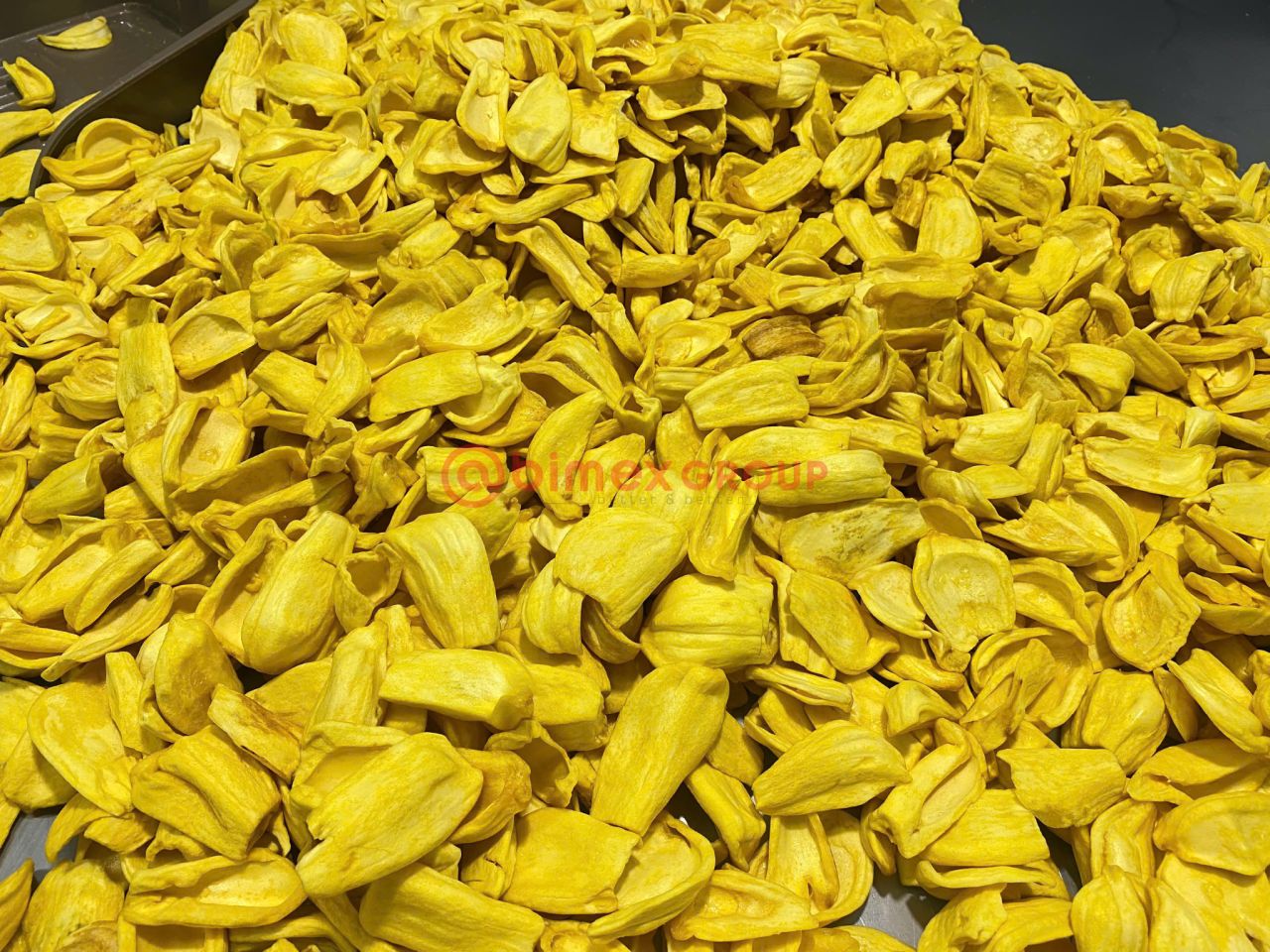
The nutritional profile of jackfruit chips starts with the fruit, but processing can substantially affect the finished product.
Fresh jackfruit contains naturally occurring carbohydrates and sugars. During chip production, much of the fruit’s water is removed. This makes the finished product more concentrated by weight than fresh fruit.
If the chips are fried, oil can also become part of the finished product. The amount retained can depend on the processing method, fruit structure, slice thickness, frying conditions, moisture removal, and post-frying oil management.
Some products may also contain added sugar, salt, seasonings, or other ingredients.
As a result, jackfruit chips nutrition facts should be based on the actual commercial formulation rather than on fresh jackfruit data alone.
Calories represent the energy supplied by the food’s carbohydrates, fat, protein, and other energy-contributing components.
For jackfruit chips, the calorie value can be influenced by several factors, including:
A lower-moisture chip can contain more energy per gram than the original fresh fruit because water contributes weight but no calories.
Fried products can also contain additional calories from oil.
However, brands should not assume that every vacuum-fried or conventionally fried jackfruit chip has a particular calorie level. Processing systems vary, and the final number should be determined from the actual product.
In the U.S., calories displayed on the Nutrition Facts panel are tied to the declared serving size. FDA guidance notes that nutrition information is generally presented per serving and that serving sizes are based on amounts people typically consume rather than a recommended amount.
Fat is especially important when evaluating jackfruit chips nutrition facts because many commercial jackfruit chips are produced using a frying process.
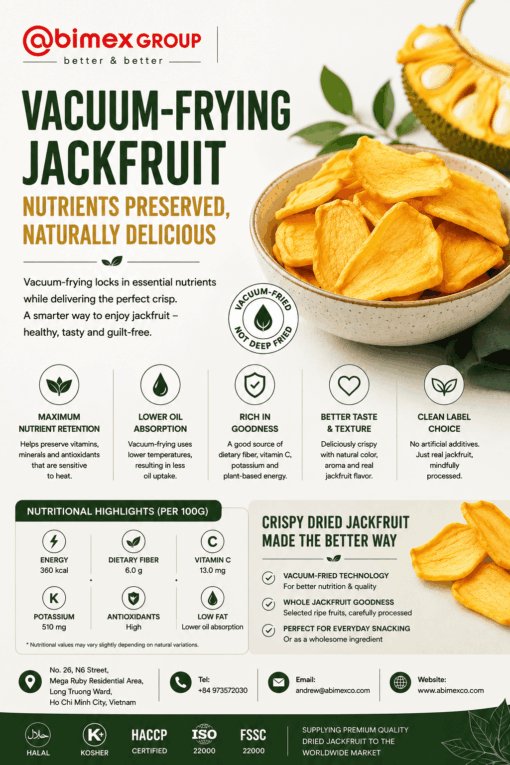
The finished fat level can be influenced by:
It is important not to assume that one frying method automatically guarantees a specific fat level.
For example, vacuum frying is often used for fruit chips, but manufacturers should not claim that every vacuum-fried product is automatically “low fat” or contains a certain amount less oil without supporting data.
Brands should request the relevant specification, nutrition analysis, or verified calculation for the finished product.
For U.S. labeling, Total Fat, Saturated Fat, and Trans Fat are among the nutrients included on the Nutrition Facts label under FDA requirements.
Jackfruit naturally contains sugar.
Drying or frying removes water, so naturally occurring sugars can become more concentrated relative to the weight of the finished food. This does not mean that the processing itself automatically creates additional sugar.
Added sugar is a separate issue.
Some jackfruit chip formulations may contain added sweetening ingredients, while others may not. Buyers should therefore check the ingredient declaration rather than judge added sugar from taste alone.
When reviewing jackfruit chips nutrition facts, brands should distinguish between:
Total sugars – sugars present in the finished product from all relevant sources.
Added sugars – sugars added during processing or formulation, as defined by the applicable labeling regulation.
In the United States, Total Sugars and Added Sugars are separately addressed on the Nutrition Facts label, with Added Sugars also subject to % Daily Value requirements.
Brands should not make a “no added sugar” claim simply because the product tastes only mildly sweet. The claim must reflect the actual formulation and applicable rules.
Serving size is one of the most important elements of a nutrition label.
If the nutritional composition per 100 grams remains the same, a larger declared serving will naturally contain more calories, fat, sugar, and other nutrients than a smaller serving.
This is why comparing two products by “calories per serving” can be misleading if the serving sizes are different.
For U.S. products, FDA states that serving sizes are based on the amounts consumers typically eat and are shown using a familiar household measure along with the metric amount in grams. They are not intended to tell consumers how much they should eat.
A brand should therefore not simply choose a convenient small serving to make the calorie number appear lower.
The appropriate serving declaration should follow the regulatory requirements for the destination market and product category.
International brands should be careful when using one packaging design across multiple markets.
For U.S. products, FDA nutrition labeling includes calories and nutrients such as total fat, saturated fat, trans fat, cholesterol, sodium, total carbohydrate, dietary fiber, total sugars, added sugars, protein, and specified vitamins and minerals.
European Union requirements use a different structure.
For most prepacked foods, the mandatory EU nutrition declaration includes energy, fat, saturates, carbohydrate, sugars, protein, and salt. These values are generally declared per 100 g or 100 ml, with per-portion information permitted additionally under applicable conditions.
This means jackfruit chips nutrition facts should be prepared for the intended destination rather than using one nutrition panel globally without regulatory review.
Brands generally have several ways to establish nutrition data, depending on the market and regulatory framework.
These can include laboratory analysis, formulation-based calculation, or recognized nutrition databases where permitted and appropriate.
In the EU, nutrition values can be based on the manufacturer’s analysis, calculations using known or actual average ingredient values, or generally established and accepted data.
For a simple single-ingredient product, calculation may sometimes appear straightforward.
But jackfruit chips can be more complicated because processing changes water content and may introduce oil or other ingredients. Using the nutrition profile of fresh jackfruit without accounting for processing would therefore be inappropriate.
When accuracy matters, brands should work from product-specific information.
A nutrition panel tells buyers how much energy and nutrients a product contains, but it does not explain the complete formulation.
The ingredient list helps answer questions such as:
This is particularly important when comparing jackfruit chips nutrition facts between different suppliers.
A chip with a noticeably sweeter taste may have a different formulation. Another product may contain different frying oil or seasoning.
Brands should request both the nutrition information and complete ingredient declaration before finalizing retail packaging.
Terms such as “low fat,” “reduced sugar,” “healthy,” “high fiber,” or similar nutrition-related claims may be regulated.
A product having less fat than another sample does not automatically mean it legally qualifies for a “low fat” claim.
Likewise, a jackfruit chip with no added sugar may still contain naturally occurring sugars.
Brands should therefore separate factual nutrition declarations from marketing claims.
The nutrition panel should reflect verified product data, while any front-of-pack claim should be checked against the legal requirements of the destination market.
This reduces the risk of creating packaging that needs to be changed after production.
When preparing jackfruit chips nutrition facts for a retail or private-label product, buyers should consider requesting:
Buyers should also confirm that the data supplied corresponds to the same product specification being ordered.
If the formulation, frying oil, seasoning, or production process changes, nutrition data may need to be reviewed again.
The most important takeaway is that jackfruit chips nutrition facts cannot be represented accurately by one universal set of calories, fat, and sugar values.
Different manufacturers may use different raw materials, frying methods, oil systems, formulations, and processing conditions.
Even serving-size conventions can differ by destination market.
For brands developing retail packaging, the better approach is to start with the exact commercial product, obtain appropriate nutrition data, identify the target market, and then format the label according to applicable requirements.
That produces a label that is both more useful to consumers and more reliable for the brand.
If your business is developing packaging or reviewing jackfruit chips nutrition facts, verified product specifications and clear supplier documentation are important starting points.
Abimex Group supports international B2B buyers sourcing jackfruit chips and other processed fruit products for retail, wholesale, distribution, private-label, and snack applications.
From product specifications and ingredient information to samples, packaging requirements, documentation, and export coordination, Abimex Group works with buyers to support sourcing programs for different markets.
Contact Abimex Group to discuss your jackfruit chip specifications, packaging format, documentation requirements, and sourcing plans.