
CASHEW NUT SHELL OIL

Desiccated coconut sieve analysis is an important tool for understanding particle-size distribution, especially when buyers need consistent coconut for bakery, confectionery, snack, filling, coating, or other food-manufacturing applications.
A product may be described as fine, medium, or another commercial grade, but these names alone do not always provide enough information about how the particles are distributed. A sieve analysis report gives buyers a more structured way to evaluate particle size by showing how much material is retained on or passes through different sieves.
However, sieve specifications can vary between manufacturers, customers, laboratories, and testing standards. For this reason, buyers should avoid assuming that a particular mesh designation or retained percentage has exactly the same meaning across every supplier.
Understanding how the report works is more useful than relying on a single number.
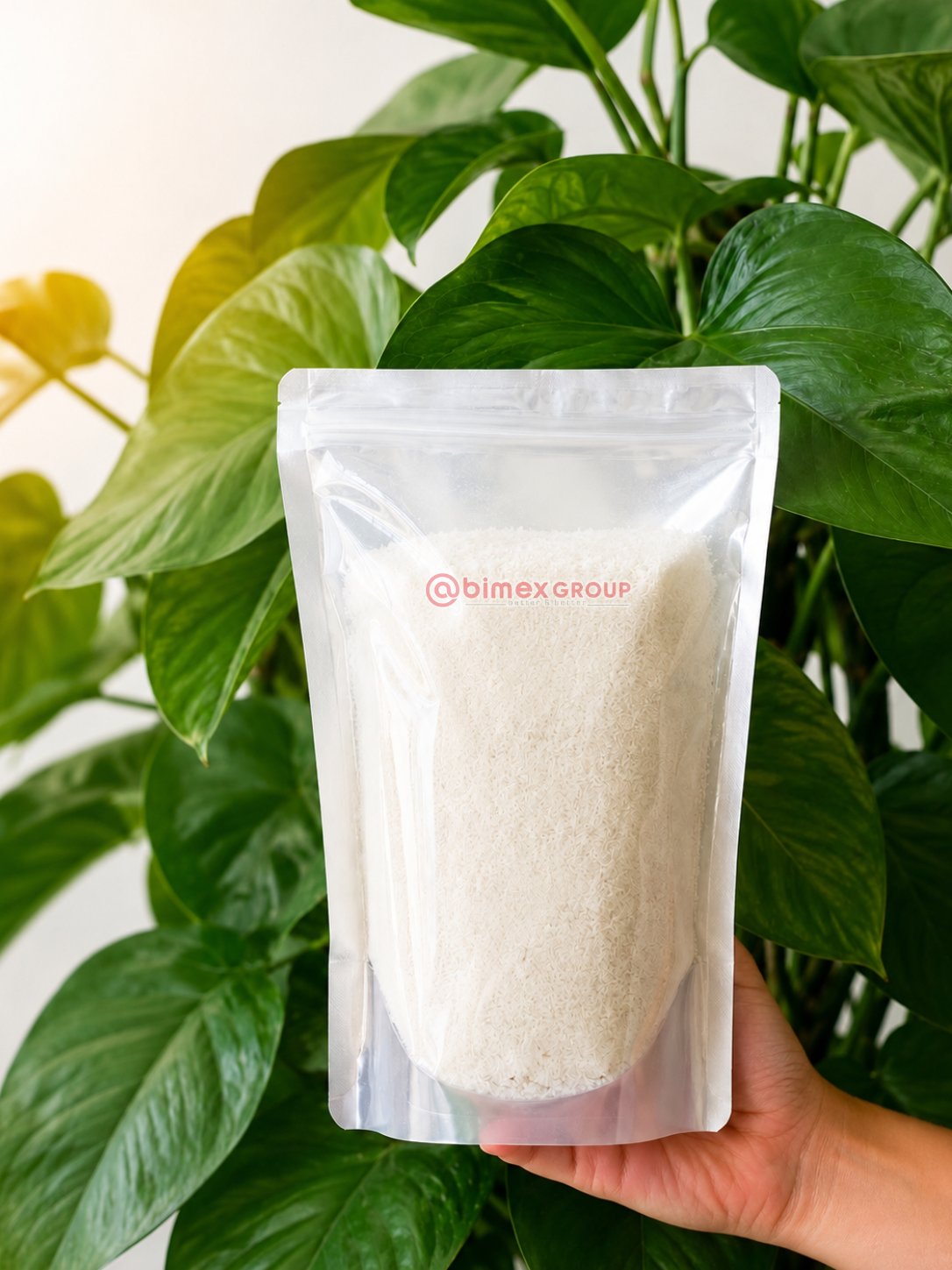
Particle size can influence how desiccated coconut looks, mixes, flows, and performs in a finished product.
For example, relatively fine particles may disperse differently in fillings or coatings, while larger particles may create a more visible coconut texture. Neither is automatically better. Suitability depends on the intended application, formulation, manufacturing process, and desired eating experience.
A desiccated coconut sieve analysis helps buyers see whether most particles are concentrated within the expected size range or whether the sample contains a broader mixture of fine and coarse material.
This can be useful when comparing samples, approving production specifications, or investigating differences between batches.
Sieve analysis is a method used to separate particles according to size.
A representative sample is placed into a series of sieves with different opening sizes. The sieves are usually arranged so that larger openings are positioned above smaller openings.
During the test, the sample is agitated according to the selected test procedure. Smaller particles pass through larger openings and continue downward until they reach a sieve they cannot pass through. Larger particles remain on upper sieves.
After the test, the material retained on each sieve is measured.
The result provides a particle-size distribution rather than simply describing the product as “fine” or “coarse.”
For desiccated coconut, the exact testing method, sieve sequence, equipment, sample preparation, and acceptance criteria should be confirmed between the supplier and buyer.
One of the first things buyers may see on a report is a reference to mesh or sieve size.
In general terms, the sieve designation describes the screening system used to separate particles by size. However, buyers should be careful when interpreting mesh numbers alone.
Different sieve standards may use different naming conventions, and a mesh designation should ideally be considered together with the actual sieve opening and the referenced test standard.
This is especially important when comparing reports from different countries or suppliers.
Instead of asking only:
“What mesh is this coconut?”
a more useful question may be:
“Which sieve standard and opening sizes are being used in this specification?”
This reduces the risk of comparing two numbers that appear similar but are based on different testing systems.
Retained percentage indicates the proportion of the tested sample that remains on a particular sieve after testing.
Imagine a sample moving through several sieve levels. Large particles may remain near the top, medium-sized particles may be retained further down, and the finest material may pass through several sieves before being collected.
The report then expresses how the sample is distributed across those sieve levels.
When reviewing a desiccated coconut sieve analysis, retained percentage is useful because it shows more than the average appearance of the product. It provides information about how much of the sample falls into different particle-size groups.
A buyer can therefore assess whether the particle distribution matches the agreed specification or approved reference sample.
The actual acceptable percentages should come from the supplier specification, customer requirement, or mutually agreed standard rather than from a universal rule.
Some reports focus on the percentage retained on each sieve, while others may also show the percentage passing through a sieve.
These two measurements describe the same particle distribution from different perspectives.
Retained refers to the material that remains on a particular sieve.
Passing refers to the material small enough to move through that sieve opening.
Buyers should check the column heading carefully before interpreting the result. Confusing “retained” with “passing” can lead to a completely different understanding of the particle-size profile.
It is also important to confirm whether results are reported individually for each sieve or cumulatively.
A common mistake is to focus only on one value.
A desiccated coconut sieve analysis is more informative when the whole distribution is reviewed.
For example, two products might show a similar result on one sieve but have different amounts of finer or larger particles elsewhere in the distribution. Those differences could affect visual appearance, mouthfeel, blending, coating behavior, or dosing during manufacturing.
Instead of asking whether one number passes, buyers can look at questions such as:
This provides a more complete picture of the product.
A finer particle size should not automatically be considered higher quality, and a larger particle size should not automatically be considered better.
Different food applications require different particle characteristics.
Finer coconut may integrate more easily into certain fillings, coatings, bakery mixes, or confectionery systems. Larger particles may provide stronger visual identity, more noticeable texture, or a different eating experience.
The appropriate grade depends on what the manufacturer wants the coconut to do.
That is why a desiccated coconut sieve analysis should be interpreted in the context of the finished product rather than as a stand-alone quality ranking.
Particle size is a specification parameter, not a universal quality score.
Two reports should not automatically be compared simply because both contain sieve data.
Before comparing results, buyers should check whether the laboratories or manufacturers used comparable methods.
Important points may include the sieve standard, sieve opening sequence, sample size, sample preparation, test duration, equipment, and reporting method.
Differences in testing procedures can influence the reported distribution.
Desiccated coconut itself can also vary in physical behavior depending on factors such as moisture, fat characteristics, particle shape, and handling. Small particles may sometimes cluster together, for example, which can affect how the sample moves during screening.
For meaningful supplier comparisons, consistency in test methodology matters.
A technical report is useful, but physical product evaluation remains important.
A sample can help buyers understand what a particular sieve distribution actually looks and feels like in practice.
When approving a new source, manufacturers may find it useful to review the sieve report together with:
This is particularly helpful when particle size affects the appearance or texture of the finished product.
A desiccated coconut sieve analysis can confirm measurable distribution, while physical testing helps determine whether that distribution works for the intended formulation.
For industrial buyers, repeatability may be just as important as the result of a single sample.
A first sample might perform well during product development, but manufacturers generally need commercial batches to remain reasonably consistent with the agreed specification.
Significant changes in particle-size distribution may influence mixing, dosing, texture, appearance, or the amount of visible coconut in the finished product.
Buyers can therefore use sieve results as one tool for monitoring production consistency.
The goal is not necessarily to make every particle identical. Agricultural ingredients naturally have some variation. The objective is to maintain a distribution that meets the agreed product specification.
For a desiccated coconut sieve analysis, useful questions include:
These questions can make supplier comparisons more meaningful than simply asking for a “fine” or “medium” grade.
Used correctly, desiccated coconut sieve analysis provides buyers with a clearer view of particle-size consistency and helps turn general grade descriptions into measurable specifications.
However, the report should not be interpreted in isolation.
Mesh terminology, sieve openings, retained percentages, test methods, product samples, and the intended food application should all be considered together. Different manufacturers and customers may use different sieve systems and acceptance criteria, so there is no single universal retained percentage or mesh designation that should automatically apply to every desiccated coconut product.
Likewise, finer or larger particles are not inherently superior. The best option is the one that meets the agreed specification and performs appropriately in the buyer’s actual application.
If your team is reviewing desiccated coconut sieve analysis results or comparing different coconut grades, clear specifications and sample evaluation can help make sourcing decisions more reliable.
Abimex Group supports international B2B buyers sourcing desiccated coconut for bakery, confectionery, snacks, cereals, fillings, coatings, and other food-manufacturing applications.
From discussions around product grades and specifications to samples, packaging requirements, documentation, and export coordination, Abimex Group works with buyers to identify suitable options for their target applications.
Contact Abimex Group to discuss your desiccated coconut requirements, preferred particle-size profile, packaging needs, and sourcing plans.