
CASHEW NUT SHELL OIL

Sourcing desiccated coconut at the right price is straightforward. Sourcing it at the right desiccated coconut quality — consistently, shipment after shipment — is where most buyers run into problems.
Moisture content that’s slightly too high leads to mould in transit. Free fatty acid levels above threshold cause rancidity within weeks of arrival. Low whiteness scores show up as off-colour flakes in your finished product. These aren’t rare issues — they’re the most common quality complaints in the desiccated coconut trade.
This guide covers the seven desiccated coconut quality parameters that matter most, what acceptable ranges look like, and how to use them to evaluate suppliers before placing an order.
Desiccated coconut is a minimally processed ingredient — fresh coconut meat, shredded and dried. Its quality is determined almost entirely at the processing stage: how fresh the raw coconut was, how quickly it was processed after harvest, how the drying was controlled, and how the finished product was stored and packed.
Unlike processed ingredients with multiple formulation steps, there is little you can do to correct desiccated coconut quality issues once the product leaves the factory. A COA (Certificate of Analysis) from a reputable supplier, verified by third-party testing, is your primary protection.
According to the Codex Alimentarius Standard CXS 177-1991 for Desiccated Coconut, international quality standards define minimum thresholds for moisture, microbiological safety, and chemical composition — giving buyers a reliable baseline for supplier evaluation.
Why it matters: Moisture content is the single most important desiccated coconut quality parameter. High moisture creates conditions for mould growth during transit and storage, shortens shelf life, and can cause clumping in the finished product.
Standard range: ≤3%
Why it matters: FFA is the primary indicator of fat quality and freshness. As coconut fat degrades, triglycerides break down into free fatty acids, producing a rancid, soapy off-flavour. High FFA is the leading cause of flavour complaints from desiccated coconut buyers.
Standard range: ≤0.1% (expressed as lauric acid)
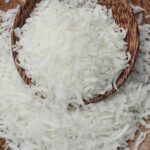
Why it matters: Desiccated coconut whiteness directly affects the visual quality of the finished product. Off-white or yellowed flakes are immediately visible in confectionery coatings, granola, and bakery applications.
Standard range: ≥90% (Hunterlab or Kett whiteness meter)
Why it matters: Water activity measures the availability of water for microbial growth, independent of total moisture content. A product can have low moisture but high water activity — creating mould risk even at apparently acceptable moisture levels.
Standard range: <0.5
Why it matters: Microbiological contamination — particularly Salmonella and E. coli — can cause product recalls, regulatory rejection at the border, and serious reputational damage. Coconut is a known risk product for Salmonella.
| Parameter | Acceptable Limit |
|---|---|
| Total Plate Count (TPC) | ≤10,000 CFU/g |
| Yeast and Mould | ≤100 CFU/g |
| Salmonella | Negative / 25g |
| E. coli | Negative / 1g |
| Coliforms | ≤10 CFU/g |
Why it matters: Fat content determines caloric value, texture contribution, and flavour richness. Buyers using desiccated coconut for nutritional labelling or specific formulation targets need confirmed fat values.
Standard ranges: Full-fat: 62–68% (dry weight basis). Reduced-fat: 35–50% (dry weight basis).
Why it matters: SO₂ is sometimes used as a preservative or bleaching agent in coconut processing. EU regulations set strict limits, and some buyers require SO₂-free product entirely.
Standard range: ≤30ppm (EU Codex); some buyers specify ≤10ppm
Step 1 — Request a full COA before sampling. A supplier who cannot provide a full COA covering all 7 desiccated coconut quality parameters promptly is not ready for export business.
Step 2 — Verify the COA against an accredited lab. For first-time suppliers, send your sample to an independent laboratory (SGS, Intertek, Bureau Veritas) and compare results. Discrepancies >10% on any parameter warrant investigation.
Step 3 — Set specification limits in your purchase order. Include your desiccated coconut quality specification as an annex with explicit rejection criteria. Example: “Moisture ≤3.0%, FFA ≤0.10%, Salmonella negative/25g.”
Step 4 — Request batch-specific COA for every shipment. Require a batch-specific COA matching the production date and lot number of your actual shipment for every order.
| Parameter | Standard Range | Primary Risk if Out of Spec |
|---|---|---|
| Moisture content | ≤3% | Mould, clumping, short shelf life |
| Free fatty acid (FFA) | ≤0.1% | Rancidity, off-flavour |
| Whiteness | ≥90% | Visual defects in finished product |
| Water activity (Aw) | <0.5 | Mould growth in storage |
| Total plate count | ≤10,000 CFU/g | Food safety risk |
| Salmonella | Negative/25g | Recall, border rejection |
| Fat content | 62–68% (full-fat) | Formulation and labelling errors |
| SO₂ residue | ≤30ppm | Regulatory non-compliance |
The international standard is ≤3% moisture content, as defined in Codex Alimentarius CXS 177-1991. Most commercial buyers specify ≤3%, with some requiring ≤2.5% for long transit routes or humid storage conditions. Moisture above 3.5% significantly increases the risk of mould development during shipping.
High free fatty acid (FFA) content means the fat in the coconut has begun to degrade, producing a rancid or soapy off-flavour that worsens over time. FFA above 0.1% suggests compromised freshness — from aged raw material, poor processing conditions, or extended storage without adequate temperature control.
Basic sensory evaluation (smell for rancidity, check for off-colour or clumping) can be done on arrival. For comprehensive desiccated coconut quality verification, send samples to an accredited third-party laboratory. Key tests: moisture content, FFA, whiteness, water activity, and full microbiological panel including Salmonella.
Whiteness affects the visual quality of finished products. In confectionery, bakery, and granola applications, consumers associate bright white coconut with freshness. Off-white or yellowed product is visible in coatings and toppings. Whiteness below 85% is typically unacceptable for premium applications.
At minimum: FSSC 22000 or ISO 22000 for food safety management, and Halal if distributing in Muslim-majority markets. Kosher for certain US and European retail channels. Organic certification (EU or USDA) if needed. Always verify that certificates are current and issued by recognised certification bodies.
Desiccated coconut quality comes down to seven measurable parameters — and none of them can be assessed without documentation. Moisture content and FFA are the most critical for shelf life and flavour. Whiteness determines visual acceptability. Microbiological results determine food safety compliance. Water activity, fat content, and SO₂ complete the full picture.
The buyers who avoid quality problems are the ones who request full COAs, verify results independently, and specify their requirements explicitly in purchase orders — before the product ships.
At Abimex Group, we supply desiccated coconut with full COA documentation for every shipment — Halal, Kosher, ISO 22000, and FSSC 22000 certified. Available in fine, medium, and coarse grades, full-fat and reduced-fat, in 25kg bags.
Contact us to request samples or specifications.