CASHEW NUT SHELL OIL

CASHEW NUT SHELL OIL
RICE PROTEIN POWDER
RICE PROTEIN POWDER
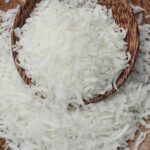
DESICCATED COCONUT
Desiccated Coconut Moisture Content is one of the most important quality parameters buyers should review before approving a product or placing a commercial order. Although desiccated coconut is dried to improve stability, its final quality still depends on how effectively moisture is controlled during production, cooling, packaging, storage, and transportation.
Excess moisture may affect texture, flowability, aroma, appearance, and storage performance. However, a low moisture result at the factory does not automatically guarantee a long shelf life. Packaging integrity, warehouse humidity, temperature, hygiene, and handling conditions must also be managed throughout the supply chain.
For importers, distributors, and food manufacturers, understanding moisture control helps reduce the risk of clumping, quality deterioration, production difficulties, and customer complaints.
Table of Contents
ToggleThe agreed Desiccated Coconut Moisture Content influences how the product behaves during storage and use. When moisture is not properly controlled, coconut particles may absorb water from the surrounding environment, especially after exposure to humid air.
This may lead to several commercial and technical concerns:
Moisture also affects how accurately the product can be weighed, mixed, dosed, or dispersed during food production. A clumped product may require additional handling and may not distribute evenly in bakery mixes, confectionery fillings, coatings, cereals, or snack products.
For this reason, moisture should not be treated only as a laboratory number. It is also a practical indicator connected to processing efficiency and final-product consistency.
A common sourcing mistake is assuming that moisture content and water activity provide identical information.
Moisture content measures the total amount of water present in a product. Water activity, meanwhile, relates to how available that water is for chemical reactions and microbial activity. Two samples may have similar moisture results but different water-activity values because of differences in composition, processing, particle structure, or formulation.
Therefore, Desiccated Coconut Moisture Content should be reviewed together with microbiological results, packaging conditions, storage requirements, and other relevant quality parameters.
Neither result should be interpreted in isolation. Buyers should establish which tests are required for their intended application and destination market before production begins.
Desiccated coconut should normally remain dry and reasonably free-flowing within the agreed product specification. When it absorbs moisture, particles may begin sticking together and forming lumps.
This can create problems for manufacturers using automatic feeding, weighing, or mixing systems. Fine-grade coconut may behave differently from Medium, Flakes, or Chips because particle size and surface area influence how the product interacts with the surrounding environment.
The effect can also vary according to fat content, production method, storage duration, and handling pressure. Therefore, buyers should evaluate the product in its actual application instead of relying only on a visual inspection of a small sample.
An approved sample may look suitable when freshly opened, but commercial performance depends on whether the same characteristics can be maintained throughout storage and production.
Effective Desiccated Coconut Moisture Content control begins during manufacturing. Drying conditions must be managed carefully to achieve the required result without negatively affecting the coconut’s natural color, aroma, flavor, or texture.
Control should continue after drying. The product must be cooled under suitable conditions before packing. If warm coconut is packed too early, temperature differences may contribute to condensation inside the packaging. If it remains exposed to humid air for too long, it may absorb moisture again.
Manufacturers should therefore maintain appropriate controls during:
A suitable result at the end of drying can be lost if later stages are not properly managed.
Packaging provides an important barrier between the coconut and the external environment. Even properly dried coconut may absorb moisture if the packaging material is unsuitable, the inner liner is damaged, or the seal is incomplete.
For export shipments, packaging may pass through several stages, including inland transportation, port handling, ocean freight, customs clearance, unloading, and destination storage. Each stage can expose the cargo to humidity, temperature changes, physical pressure, and accidental damage.
When reviewing Desiccated Coconut Moisture Content, buyers should also confirm:
Strong outer packaging is important, but the moisture barrier and sealing quality are especially critical for protecting the product itself.
Desiccated coconut should be stored in a clean, cool, dry, and well-ventilated place. It should be protected from direct sunlight, water, pests, chemicals, and products with strong odors.
During ocean transportation, containers may move through different climate zones. Temperature changes can create condensation on the container walls or ceiling. This phenomenon, often called “container rain,” may damage cartons or outer bags and increase the risk of moisture exposure if the primary packaging is compromised.
A clean and dry container should be inspected before loading. Exporters should check for leaks, unusual odors, wet floors, mold, residues from previous cargo, and structural damage.
Desiccants or protective container materials may help manage humidity in some situations, but they cannot correct wet cargo, poor packaging, a leaking container, or unsuitable loading practices.
A Certificate of Analysis should report the moisture result for the actual production batch whenever this is required by the buyer. However, one laboratory result does not prove long-term consistency across multiple shipments.
Reliable suppliers should maintain appropriate sampling, testing, traceability, and record-keeping procedures. Buyers may also request representative samples from normal commercial production rather than samples prepared only for presentation.
When evaluating Desiccated Coconut Moisture Content, importers should confirm:
Testing methods and acceptance criteria should be agreed upon before production. Differences in sampling location, sample preparation, laboratory procedure, or equipment may produce different results.
It is important not to assume that meeting a moisture limit alone guarantees the declared shelf life. Desiccated coconut naturally contains fat, and fat quality may change over time depending on temperature, oxygen exposure, packaging, and storage duration.
Buyers should also consider:
Shelf life is supported by a complete quality-protection system—not by a single specification. A technically compliant product may still deteriorate if it is stored incorrectly or exposed to moisture after opening.
Before approving a supplier, buyers should treat Desiccated Coconut Moisture Content as part of a broader sourcing evaluation.
Useful questions include:
The lowest price per kilogram may not provide the lowest total cost. Moisture-related clumping, damaged packaging, inconsistent processing performance, or shortened storage stability may create additional expenses for inspection, repacking, production adjustment, or product replacement.
Consistent Desiccated Coconut Moisture Content supports texture, flowability, processing performance, and storage stability. However, moisture control must continue beyond the drying stage through cooling, handling, packaging, warehousing, transportation, and destination storage.
Buyers should review moisture results together with water activity where relevant, microbiological safety, fat quality, packaging performance, storage conditions, and batch documentation. This broader approach provides a more reliable basis for evaluating shelf life and commercial suitability.
Abimex Group supplies Vietnamese desiccated coconut in Fine, Medium, Flakes, and Chips grades for importers, distributors, food manufacturers, and private-label businesses. Our team can discuss your required grade, particle size, fat content, quality parameters, packaging format, and destination-market requirements.
Contact Abimex Group to request product specifications, quotations, or samples for your desiccated coconut sourcing needs.