CASHEW NUT SHELL OIL

CASHEW NUT SHELL OIL
RICE PROTEIN POWDER
RICE PROTEIN POWDER
DESICCATED COCONUT
Bulk Soft Dried Mango for Bakery and Food Manufacturing Applications provides manufacturers with a versatile tropical fruit ingredient that can add natural mango flavor, chewy texture, attractive color, and product differentiation to a wide range of formulations.
Soft dried mango is not limited to direct snacking. Depending on its formulation, moisture, cut size, and physical properties, it can be used in bakery products, cereals, confectionery, desserts, snack mixes, and food-service applications. However, industrial buyers must evaluate more than taste and appearance when selecting a suitable product.
Consistency, ingredient declaration, moisture control, cut size, packaging, and performance during processing all affect whether the mango will work successfully in commercial production.
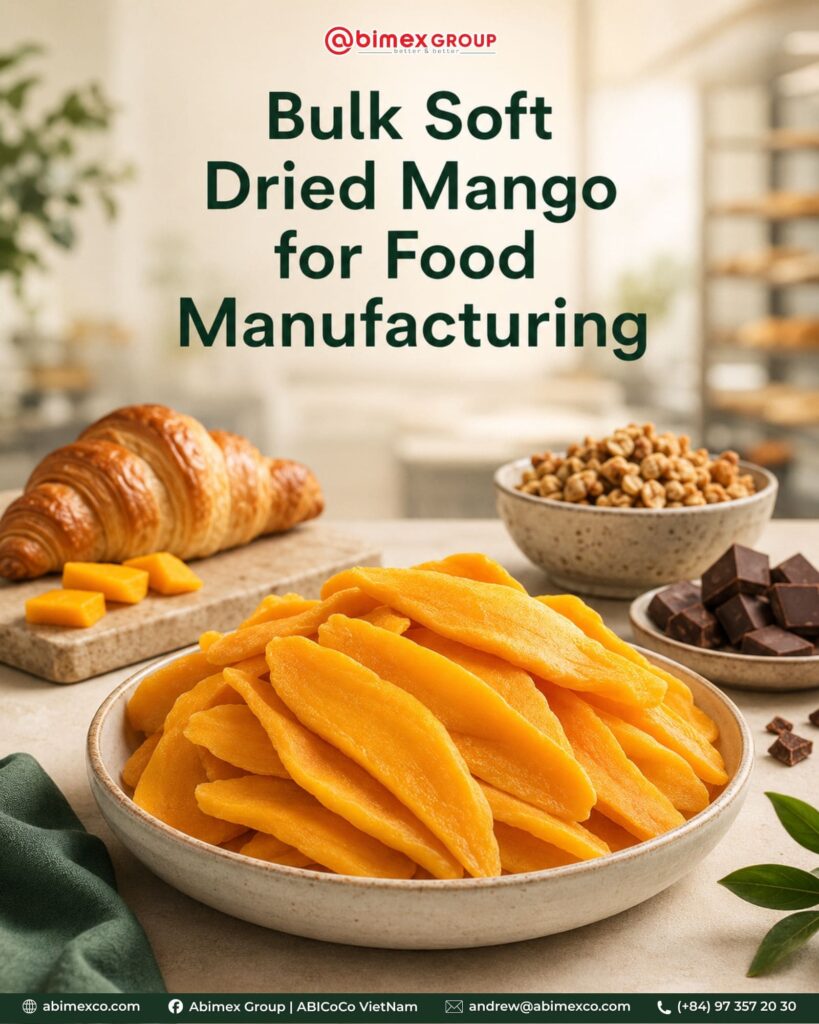
Table of Contents
TogglePurchasing Bulk Soft Dried Mango for Bakery and Food Manufacturing Applications allows manufacturers to use the product according to their own recipes, production processes, and packaging systems.
Bulk supply is particularly suitable for companies that use dried mango as an ingredient rather than selling it as a finished snack. Buyers can select the appropriate formulation and cut size for their application and arrange local processing, mixing, portioning, or repacking.
Soft dried mango can provide several functional and sensory benefits:
However, these benefits depend on selecting the correct specification. A product designed for direct snacking may not perform effectively in automated bakery or cereal production.
In bakery manufacturing, Bulk Soft Dried Mango for Bakery and Food Manufacturing Applications can be incorporated into cookies, cakes, muffins, bread, pastries, fillings, and toppings.
The appropriate cut size depends on the final product. Small mango pieces may distribute more evenly through cookie dough, muffin batter, or bread mixes. Larger pieces can create a more visible fruit inclusion in premium cakes, pastries, and artisanal bakery products.
Manufacturers should consider how the mango interacts with other ingredients during mixing and baking. Moist fruit pieces may stick together, absorb flour, or affect moisture distribution. They can also respond differently to heat depending on their size, formulation, and location within the product.
Production trials are therefore essential. Testing allows manufacturers to assess:
The approved sample should represent the commercial specification as closely as possible.
Soft dried mango can be added to granola, muesli, breakfast cereals, trail mixes, nut combinations, and tropical fruit blends.
For these applications, the product must be compatible with dry ingredients. Excessively moist or sticky pieces may attach to cereal, nuts, seeds, or packaging surfaces. This can create uneven distribution and make automated weighing or filling more difficult.
Manufacturers may need mango pieces with controlled surface moisture and a suitable cut size. The product should remain soft without becoming so sticky that it slows production.
When developing a mix, buyers should also examine the balance between mango pieces and other ingredients. Large pieces can create visual impact, while smaller pieces may provide more even flavor distribution.
Storage trials are important because ingredients with different moisture levels may interact inside the same package. Suitable packaging helps protect the final product from humidity, oxygen, and unwanted texture changes.
Bulk Soft Dried Mango for Bakery and Food Manufacturing Applications can also be used in chocolate bars, coated fruit products, confectionery fillings, fruit-and-nut clusters, and premium gift collections.
In chocolate applications, surface condition is particularly important. Mango pieces that are too moist or sticky may be difficult to coat evenly. Differences in size can also result in inconsistent chocolate coverage and final product weight.
Manufacturers should confirm:
Trials should be completed using the actual chocolate, coating, or confectionery process. A product that performs well as a snack may require adjustment before it can be used in industrial coating equipment.
Soft dried mango may be used as an inclusion or topping for yogurt, ice cream, dessert cups, puddings, and food-service products.
The product can also be chopped, blended, or rehydrated depending on the recipe. However, manufacturers should test how the mango reacts to liquids, low-temperature storage, and extended contact with dairy or dessert components.
Relevant considerations include:
Food-service buyers may prefer larger packs, while industrial manufacturers may require packaging that integrates efficiently with their ingredient-handling process.
The formulation of Bulk Soft Dried Mango for Bakery and Food Manufacturing Applications should match the intended product positioning and destination-market requirements.
Available commercial products may contain added sugar, preservatives, or other processing ingredients. Natural options without added sugar or sulfur dioxide may also be available, depending on the supplier and production conditions.
Buyers should not assume that “natural,” “no added sugar,” “unsweetened,” and “no preservatives” mean the same thing. Each claim has a different meaning and may be regulated differently across markets.
Before confirming an order, manufacturers should request:
Any marketing claim used on the finished product should be supported by the approved formulation and destination-market regulations.
Cut size influences product appearance, labor requirements, production performance, and price.
Large mango slices may work well for direct retail or decorative bakery applications. Strips, cubes, or smaller pieces may be more suitable for cereal, cookies, bread, chocolate, and automated packing.
Customized cutting may increase processing time, labor, product losses, and cost. Buyers should therefore avoid requesting a smaller cut unless it provides a clear technical or commercial benefit.
The following questions should be considered:
Clear tolerances help prevent disagreements between the approved sample and commercial shipments.
The defining characteristic of soft dried mango is its soft and chewy texture. However, maintaining this texture while controlling stickiness can be challenging.
If moisture is too high, the pieces may clump together, interfere with weighing equipment, or create inconsistent filling. If the product is too dry, it may become tough and less appealing.
For automated production lines, buyers should conduct trials using realistic quantities. A small sample may be sufficient for sensory evaluation but may not reveal how the product behaves in a hopper, conveyor, weighing machine, or packing system.
When evaluating Bulk Soft Dried Mango for Bakery and Food Manufacturing Applications, manufacturers should assess both sensory quality and operational performance.
Bulk packaging must protect dried mango from moisture, oxygen, contamination, odor absorption, and physical damage during transportation and storage.
Buyers should confirm:
The most attractive product is not necessarily the most suitable industrial ingredient. Manufacturers need consistency in color, flavor, moisture, cut size, texture, and ingredient composition across repeat orders.
A written specification and approved reference sample provide stronger protection than relying only on product photographs or informal descriptions.
A suitable supplier should understand the difference between producing a retail snack and supplying an industrial ingredient.
Before purchasing Bulk Soft Dried Mango for Bakery and Food Manufacturing Applications, buyers should discuss:
Importers should also provide realistic forecasts. Mango is an agricultural product, and raw material availability can vary by season. Advance planning gives suppliers more time to prepare raw materials, production capacity, packaging, inspections, and logistics.
Bulk Soft Dried Mango for Bakery and Food Manufacturing Applications offers manufacturers a flexible ingredient for bakery, cereal, confectionery, chocolate, desserts, snack mixes, and food-service products.
Abimex Group supplies Vietnamese soft dried mango in standard and natural formulations, including options without added sugar or sulfur dioxide, subject to the agreed specification and production availability.
We support international buyers with product information, specification discussions, sample evaluation, customized cut sizes, bulk packaging, export documentation, and shipment planning.
Contact Abimex Group to discuss your application, required formulation, cut size, packaging, order volume, and destination market. Our team will help you evaluate a suitable soft dried mango option for your production needs.