CASHEW NUT SHELL OIL

CASHEW NUT SHELL OIL
RICE PROTEIN POWDER
RICE PROTEIN POWDER
DESICCATED COCONUT
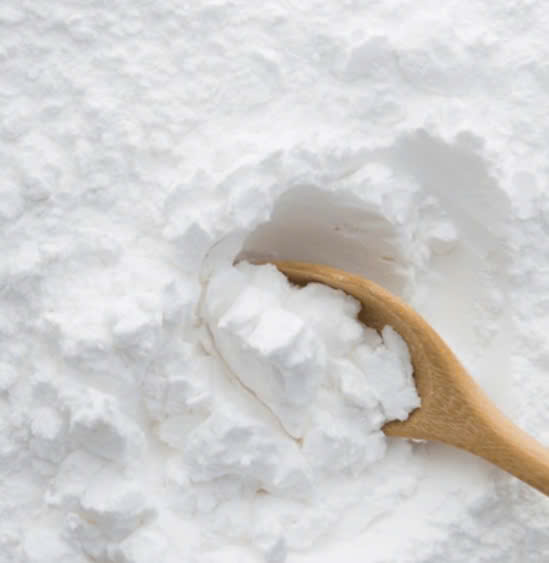
Tapioca starch in bakery and ice cream is used for much more than simple thickening. Derived from cassava, tapioca starch can support texture, moisture management, binding, softness, viscosity, and product stability depending on the formulation and starch grade.
In bakery products, it can help improve structure, tenderness, chewiness, and moisture retention. In ice cream and frozen desserts, it can contribute to body, smoothness, viscosity, and better control of water during freezing and thawing.
These functions make tapioca starch attractive to food manufacturers looking for versatile ingredients that can be adapted to different processing systems.
However, performance depends on the complete formulation. Native and modified tapioca starch do not behave in exactly the same way, and the correct choice should be based on the intended application, process conditions, desired texture, and storage requirements.
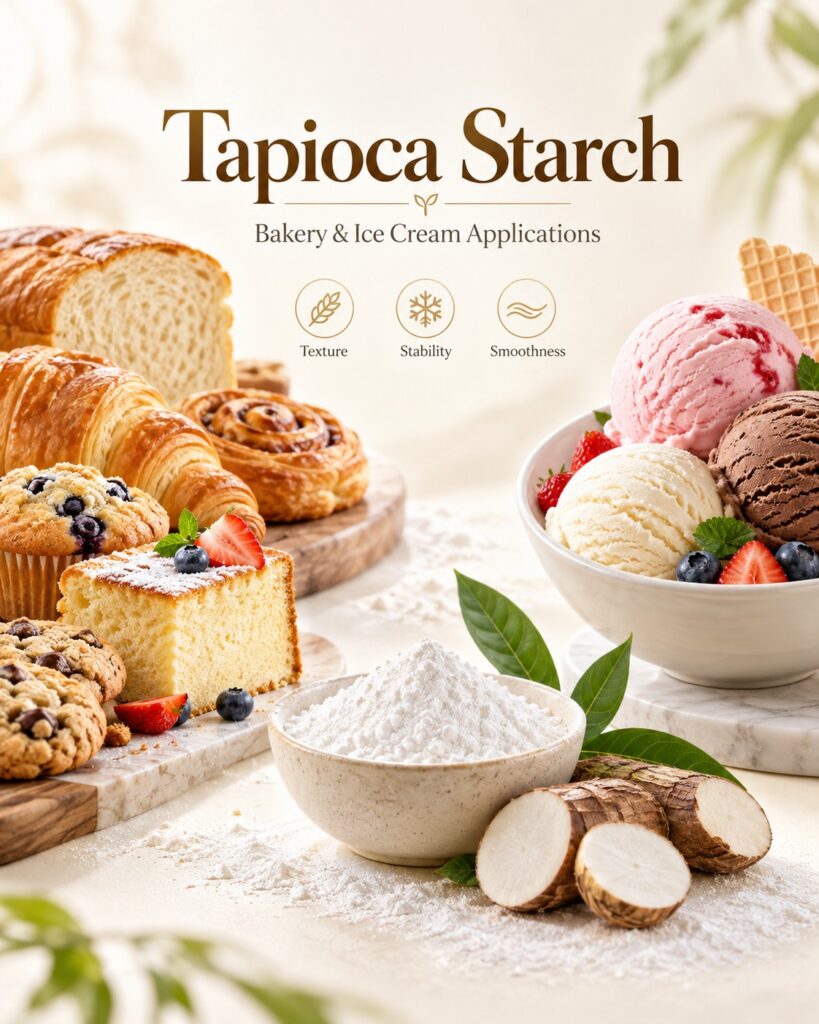
Table of Contents
ToggleTapioca starch is extracted from cassava roots.
It is a fine, white starch with a relatively neutral flavor and broad food-processing functionality.
When heated with water, tapioca starch granules absorb moisture, swell, and gelatinize. This creates viscosity and structure.
Depending on the application, tapioca starch can help with:
These properties explain why tapioca starch in bakery and ice cream can serve different purposes even though the two product categories are very different.
Bakery products depend heavily on the relationship between flour, starch, water, fat, sugar, protein, and heat.
Tapioca starch can influence this relationship by interacting with water and contributing to the structure of the final product.
One common reason for using tapioca starch in bakery applications is texture.
In cakes, muffins, cookies, and similar products, tapioca starch may help create a softer or more tender eating quality depending on the formulation.
Because starch can bind water and gelatinize during baking, it may contribute to the internal crumb structure.
This can be especially useful in formulations where manufacturers want to balance:
The effect will vary depending on how much tapioca starch is used and what other ingredients are present.
Tapioca starch is also known for contributing to chewy or elastic textures.
This makes it useful in certain specialty bakery products, including:
The elastic character does not come from tapioca starch alone, but the starch can help support a more flexible structure.
This is one reason it is often used together with other flours and starches rather than as a complete replacement for wheat flour.
Moisture balance is important in bakery products.
If a product loses too much moisture, it may become:
Tapioca starch can help hold water within the product matrix.
This may support softness and reduce excessive moisture loss during storage.
However, it should not be presented as a guaranteed shelf-life extender.
Actual bakery shelf life still depends on:
A more accurate description is that tapioca starch can help support moisture and texture stability.
Tapioca starch is also useful in bakery fillings.
Fruit fillings, cream-style fillings, and other semi-solid systems often need enough viscosity to remain stable during production and baking.
A suitable tapioca starch may help:
For simple fillings, native tapioca starch may be sufficient.
For applications involving stronger heat, acidity, or freeze-thaw stress, modified tapioca starch may be more appropriate.
Gluten-free bakery products can be difficult to formulate because wheat gluten normally provides important structure and elasticity.
Tapioca starch is commonly used as part of a gluten-free flour or starch blend.
Potential benefits include:
However, tapioca starch alone cannot fully reproduce gluten.
Manufacturers usually combine it with other ingredients such as:
The final performance depends on the full recipe.
Tapioca starch can also contribute to texture in crisp bakery products.
In cookies, crackers, and baked snacks, starch selection can influence:
A formulation with tapioca starch may create a different bite compared with one based only on wheat flour or another starch.
This can be useful when manufacturers want to design a specific sensory profile.
Ice cream is a more complex frozen system.
Its texture depends on the relationship between:
Tapioca starch can support some of these functions by increasing viscosity and helping manage water.
One of the main reasons for using tapioca starch in bakery and ice cream is its ability to influence texture.
In ice cream, tapioca starch can help create a fuller body.
This may contribute to:
The exact result depends on the starch grade and processing conditions.
Tapioca starch should not automatically be considered a complete stabilizer system, but it can contribute to the overall texture of the mix.
Before freezing, ice cream mix needs a suitable viscosity.
If the mix is too thin, ingredient distribution and final texture may be affected.
Tapioca starch can increase viscosity by absorbing water and forming a structured phase.
This may help:
The starch needs to be properly hydrated according to the production process.
Water behavior is extremely important in frozen desserts.
During freezing, part of the water forms ice crystals.
If water is not properly controlled, the texture may become coarse or icy.
Tapioca starch can help bind some available water within the food system.
This can support better water distribution.
However, it is important not to overstate the effect.
Ice crystal control also depends strongly on:
Tapioca starch is one component of the formulation, not the only factor.
Frozen products may experience temperature fluctuations during storage or distribution.
When a frozen product partially melts and refreezes, water can move and ice crystals can grow.
Certain modified tapioca starches are designed to provide improved freeze-thaw stability.
This can be useful in:
A modified starch may help reduce undesirable water separation or texture breakdown.
Native tapioca starch may be less suitable for repeated freeze-thaw stress depending on the formulation.
A smoother frozen dessert generally has better control of free water and ice crystal growth.
Tapioca starch may contribute indirectly by increasing viscosity and binding water.
This can help the product maintain a more cohesive texture.
However, it would be inaccurate to say that tapioca starch alone “prevents ice crystals.”
The actual frozen texture depends on the full formulation and cold-chain management.
In some lower-fat frozen dessert formulations, manufacturers may use starch to help create body that would otherwise come partly from fat.
Tapioca starch can contribute to:
However, starch does not replicate fat exactly.
The formulation must still be balanced carefully to avoid an overly gummy or heavy texture.
Choosing between native and modified starch is important.
Native tapioca starch may be suitable for:
It offers good thickening and a clean flavor profile.
However, it can be more sensitive to:
Modified tapioca starch may be preferred for:
Depending on the modification, it may offer improved:
The correct grade depends on the manufacturing process.
There is no universal dosage that works for every product.
The appropriate level depends on:
Using too little may provide insufficient functionality.
Using too much may create:
Pilot testing is therefore essential.
The same starch can perform differently depending on how it is processed.
Manufacturers should consider:
For bakery products, starch must perform through mixing, baking, cooling, and storage.
For ice cream, it must perform through mix preparation, heating, cooling, aging, freezing, and frozen storage.
Technical data sheets are useful, but they cannot fully predict performance in a specific food formulation.
Food manufacturers should test tapioca starch in the actual product.
For bakery, this may include evaluating:
For ice cream, useful evaluations may include:
The correct testing method depends on the product.
One mistake is assuming that all tapioca starch grades perform the same way.
Another is choosing starch only based on price.
An inexpensive starch may create processing problems if it does not tolerate:
Manufacturers should also avoid treating tapioca starch as a complete replacement for all stabilizers or structural ingredients.
The best results usually come from understanding its specific role within the formulation.
Tapioca starch is attractive because it offers a combination of:
For bakery manufacturers, it can support softness, chewiness, moisture management, and filling stability.
For ice cream manufacturers, it can contribute to viscosity, body, water management, and frozen texture.
This makes tapioca starch in bakery and ice cream a useful functional ingredient across very different product categories.
Tapioca starch in bakery and ice cream demonstrates how one ingredient can serve multiple technical functions depending on the formulation.
In bakery products, it can help with:
In ice cream and frozen desserts, it can support:
However, the final performance depends on the starch grade, processing conditions, complete formulation, and storage system.
Native tapioca starch may be suitable for straightforward applications, while modified tapioca starch can provide additional stability for more demanding processes.
For food manufacturers, the best approach is to define the target function first, select the appropriate starch grade, and confirm performance through practical application testing.
Abimex Group supplies Vietnamese native and modified tapioca starch for international food manufacturers, ingredient distributors, bakery companies, frozen-food manufacturers, and other industrial customers.
Starch solutions can be discussed for applications including:
Buyers can request product specifications, samples, available technical documentation, and quotations based on their application requirements.