CASHEW NUT SHELL OIL

CASHEW NUT SHELL OIL
RICE PROTEIN POWDER
RICE PROTEIN POWDER
DESICCATED COCONUT
When developing tapioca cat litter for different markets, formulation is only part of the product design. Granule size and particle shape can also influence how the litter behaves in the litter box and how consumers perceive the product.
For distributors, importers, and private-label brands, understanding tapioca cat litter granule size can help define the right product specifications for different market segments.
Here are five important factors to consider.
Table of Contents
ToggleParticle size affects how litter interacts with liquid.
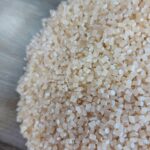
Smaller particles generally provide more surface contact within a given volume, while larger granules create a different structure with larger spaces between particles. In a clumping litter formulation, these characteristics may influence how liquid spreads through the litter before a clump forms.
However, granule size should not be evaluated independently. The behavior of cassava cat litter also depends on starch composition, moisture level, particle density, processing conditions, and other ingredients in the formulation.
For B2B buyers, this means two products with similar-looking granules may perform differently.
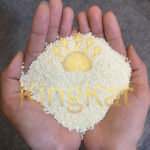
Tapioca cat litter can be manufactured in different physical formats, including granules and compact pellet-like particles.
Particle geometry influences how individual pieces contact and interact with each other when exposed to moisture. A more uniform particle distribution may produce different clump characteristics compared with a product containing a wider range of particle sizes.
This does not mean one shape is universally better.
The appropriate particle design depends on the desired balance between clumping behavior, product texture, tracking, dust management, and manufacturing specifications.
Tracking occurs when litter particles leave the litter box on a cat’s paws or fur.
Fine and lightweight particles may be more easily transported outside the litter box under certain conditions. Larger or heavier particles may behave differently, but particle size alone does not determine tracking.
Particle density, surface texture, litter depth, cat behavior, paw structure, and even the design of the litter box can influence the consumer experience.
Therefore, distributors should be cautious with absolute claims such as “non-tracking.” A more responsible approach is to compare finished products under defined test conditions.
Scooping is an important part of everyday litter-box use, particularly for clumping cat litter.
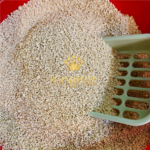
The interaction between particle size and clump structure can affect how easily a formed clump can be separated from surrounding clean litter. Granules also need to work effectively with commonly used litter scoops.
Very fine particles may pass through scoop openings differently from larger particles, while larger particles may require different scoop designs.
For private-label projects, evaluating the complete user experience—not simply the appearance of the granule—is therefore important.
One of the most important considerations for distributors is that there is no single best granule size for tapioca cat litter across every market.
Different consumers may prioritize different characteristics. One market may favor a finer texture and compact clumps, while another may place greater emphasis on particle cleanliness, tracking management, or ease of scooping.
Packaging format, target retail price, cat-owner habits, competing products, and local market expectations should all be considered when defining product specifications.
Before selecting a cassava cat litter specification, distributors should evaluate several characteristics together:
Granule size and size distribution
Particle shape and density
Clumping behavior
Tracking tendency
Dust characteristics
Scooping experience
Packaging requirements
Target consumer positioning
Most importantly, these factors should be assessed using actual finished-product samples rather than assumptions based only on raw materials or particle size.
As a tapioca cat litter manufacturer, we understand that international markets may require different product specifications.
Granule size should therefore be treated as part of the complete product-development process—not as an isolated technical parameter. Formulation, processing technology, particle structure, packaging, and target-market requirements need to work together.
For distributors and private-label partners, this creates an opportunity to develop a cassava-based cat litter specification aligned with the intended market positioning.
Looking to develop a tapioca cat litter line for your market? Contact us to discuss granule specifications, product samples, OEM/private-label requirements, packaging options, and distributor cooperation.