CASHEW NUT SHELL OIL

When food manufacturers and R&D teams specify desiccated coconut for a new product, the choice of fat grade — full-fat or reduced fat desiccated coconut — is one of the first decisions to make. It affects flavour intensity, texture contribution, caloric labelling, shelf life, and how the ingredient behaves during processing.
This guide compares full-fat and reduced fat desiccated coconut across six essential dimensions, with practical guidance for matching the right grade to your specific application.
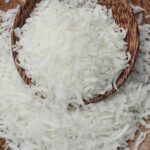
Full-fat desiccated coconut is produced by shredding fresh coconut meat and drying it to ≤3% moisture. The natural fat content — typically 62–68% on a dry weight basis — is retained throughout the process.
Reduced fat desiccated coconut starts with the same process but adds one additional step: mechanical pressing (expeller pressing) to remove a portion of the naturally occurring coconut oil. Depending on the degree of pressing, fat content can be reduced to 35–50%. Importantly, no chemical solvents are used in standard production — it is a purely mechanical process.
This distinction matters for clean label positioning. According to the Codex Alimentarius Standard CXS 177-1991 for Desiccated Coconut, both full-fat and reduced-fat grades are recognised product categories — giving manufacturers a standardised baseline for specification.
| Parameter | Full-Fat | Reduced Fat |
|---|---|---|
| Fat content (dry weight) | 62–68% | 35–50% |
| Energy (per 100g, approx.) | 660–680 kcal | 450–520 kcal |
| Saturated fat | 55–60g/100g | 30–45g/100g |
| Primary fat type | Lauric acid (MCT) | Lauric acid (MCT) — reduced |
For manufacturers developing reduced-calorie or lower-fat products, reduced fat desiccated coconut offers a meaningful caloric reduction while maintaining the coconut ingredient identity on the label.
Fat is a primary carrier of flavour compounds. Full-fat desiccated coconut has a richer, more pronounced coconut flavour. Reduced fat desiccated coconut has a noticeably milder flavour profile — the coconut character is present but more subtle, which can be an advantage in applications where coconut should be a background note rather than the dominant flavour.
Full-fat desiccated coconut delivers rich, moist mouthfeel with slight oiliness — positive in confectionery contexts, but can feel heavy in health food applications. It contributes significant fat to the formulation.
Reduced fat desiccated coconut has a drier, lighter texture with less oiliness on the palate — preferred in reduced-fat product lines. Lower fat contribution is useful when total fat content of the finished product must be controlled.
| Shelf Life Factor | Full-Fat | Reduced Fat Desiccated Coconut |
|---|---|---|
| Typical shelf life (sealed) | 12 months | 12–18 months |
| Rancidity risk | Higher | Lower |
| FFA development rate | Faster | Slower |
| Packaging requirement | Nitrogen-flushed recommended | Standard sealed sufficient |
For manufacturers with long supply chains or extended warehouse storage, reduced fat desiccated coconut offers a meaningful shelf life advantage over full-fat grades.
Full-fat desiccated coconut cannot support “low fat” claims in most markets, but can support MCT/lauric acid content claims — relevant for keto, functional health, and sports nutrition segments.
Reduced fat desiccated coconut can support “reduced fat” or “lower fat” claims (vs full-fat equivalent) — typically requiring at least 25–30% fat reduction vs a reference product. It can also support “lower calorie” claims relative to full-fat. Both grades support “natural”, “plant-based”, and “no artificial ingredients” claims when produced by mechanical pressing only.
Reduced fat desiccated coconut is made from the same fresh coconut meat as full-fat. After shredding and drying, the coconut undergoes mechanical pressing (expeller pressing) to remove a portion of the naturally occurring coconut oil, reducing fat content from the natural 62–68% to approximately 35–50%. No chemical solvents are used in standard production.
Yes, but the flavour is milder than full-fat. The characteristic coconut flavour comes partly from fat-soluble aromatic compounds — reducing fat content reduces the intensity of these flavour carriers. Reduced fat desiccated coconut is suitable for applications where a subtle coconut note is desired, or where other flavours should not be overwhelmed by coconut.
This depends on the health goal. Reduced fat desiccated coconut has fewer calories and less saturated fat. Full-fat is higher in MCTs (medium-chain triglycerides, primarily lauric acid), which have different metabolic properties than long-chain saturated fats. Neither is inherently “healthier” — the choice depends on the intended application and nutritional positioning.
Both grades should have FFA ≤0.1% (expressed as lauric acid) at time of production. Because reduced fat desiccated coconut contains less fat overall, the absolute risk of rancidity is lower — but FFA should still be specified and verified on the COA, particularly for full-fat grades.
Not on a 1:1 basis without recipe adjustment. Lower fat content means less fat contribution to the formulation — which may require compensating fat from another source. Texture and flavour will also differ. We recommend requesting samples of both grades and conducting comparative bench trials before switching grade in an established formulation.
The choice between full-fat and reduced fat desiccated coconut is not a quality question — it is a formulation question. Full-fat delivers maximum coconut flavour, rich mouthfeel, and functional fat contribution. Reduced fat desiccated coconut delivers a milder, more versatile ingredient with longer shelf life, lower caloric contribution, and more flexibility in reduced-fat and health-positioned product lines.
At Abimex Group, we supply both full-fat and reduced fat desiccated coconut in fine, medium, and coarse grades — Halal, Kosher, ISO 22000, and FSSC 22000 certified, with batch-specific COA for every shipment.
Contact us to request samples of both grades or a technical specification sheet.