CASHEW NUT SHELL OIL

CASHEW NUT SHELL OIL
RICE PROTEIN POWDER
RICE PROTEIN POWDER
DESICCATED COCONUT
Native vs modified tapioca starch is an important comparison for food manufacturers because both products come from cassava, but they do not always behave the same way during processing.
Tapioca starch is widely used in food production for thickening, binding, texture development, moisture management, and product stability. However, choosing between native and modified tapioca starch depends on much more than price.
Manufacturers need to consider:
For simple formulations, native tapioca starch may provide sufficient functionality. For more demanding applications, modified tapioca starch may offer greater processing stability.
Understanding these differences can help food companies select a more suitable starch for their products.
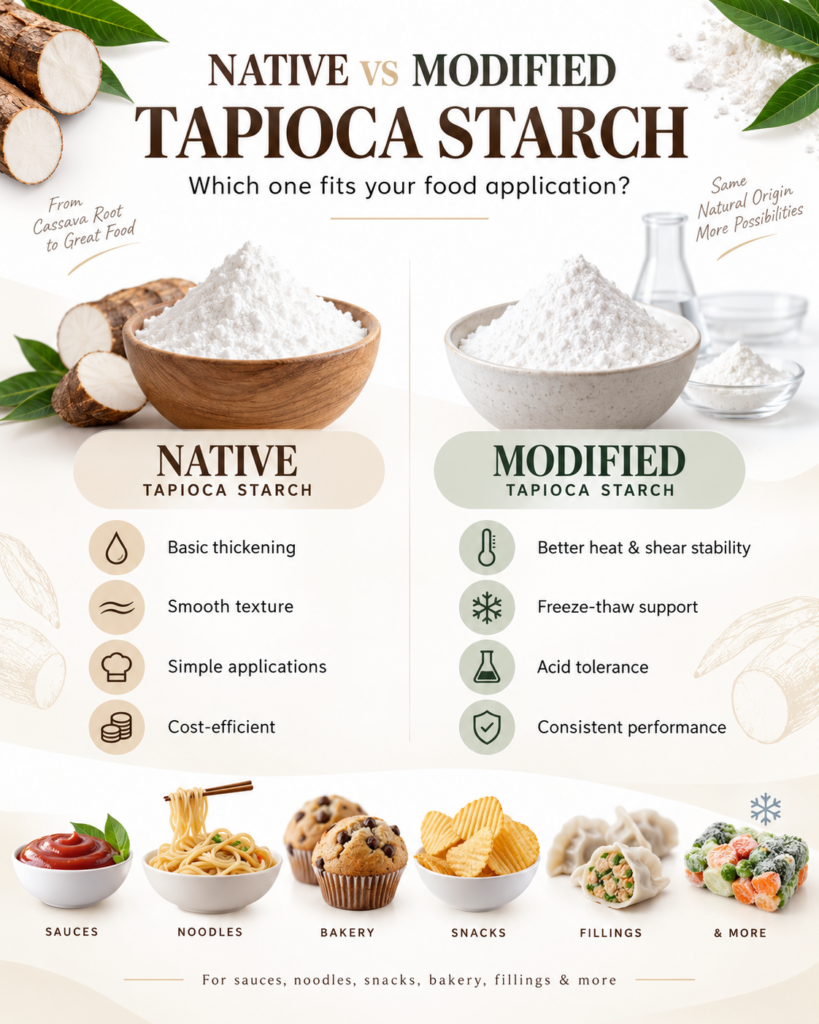
Table of Contents
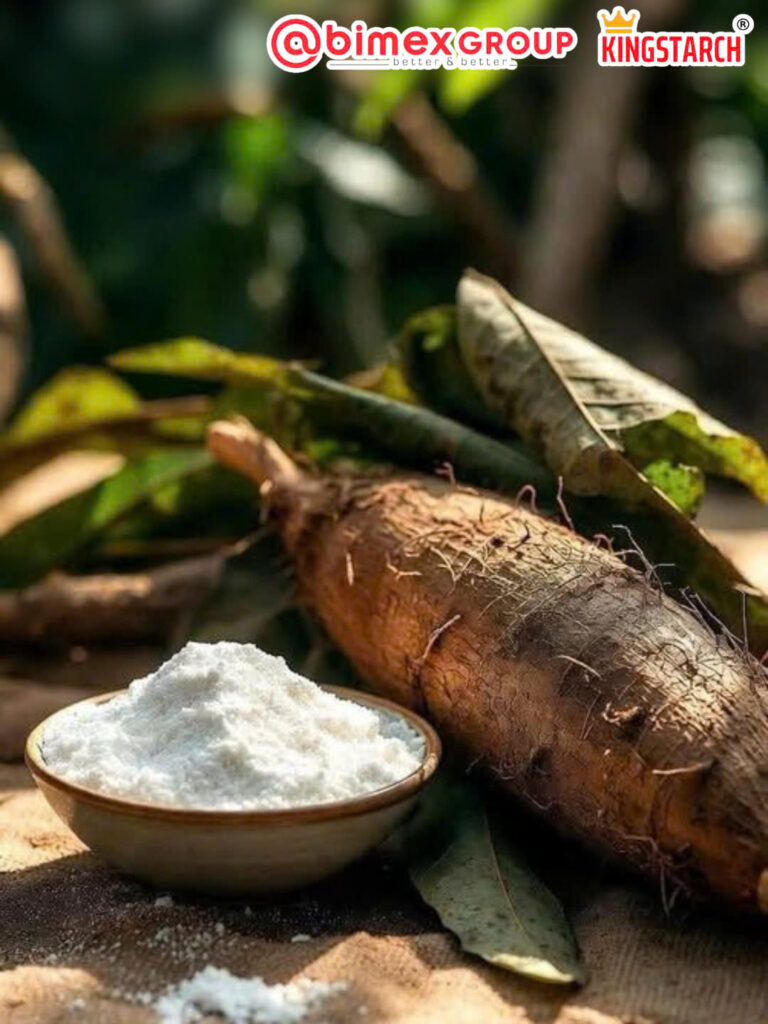
ToggleNative tapioca starch is extracted from cassava roots and used without intentional chemical or physical modification to change its basic functional characteristics.
It is known for properties such as:
When heated with water, native tapioca starch absorbs moisture and swells.
As the starch granules gelatinize, the mixture becomes thicker and develops viscosity.
This makes native tapioca starch suitable for many common food applications.
Typical uses may include:
However, native starch may become less stable when exposed to demanding processing conditions.
Modified tapioca starch is tapioca starch that has been treated to improve or adjust certain functional properties.
The objective is not simply to make starch “stronger.”
Different modifications are designed for different processing needs.
Depending on the starch grade, modified tapioca starch may provide improved resistance to:
Some grades may also be designed to provide specific viscosity, texture, water-binding, or cold-processing characteristics.
This makes modified starch useful in industrial food production where the process is more demanding than simple cooking.
The key difference between native vs modified tapioca starch is processing stability.
Native starch works well under relatively mild conditions.
However, when exposed to strong heat, mechanical shear, acidity, or repeated freezing and thawing, its viscosity and structure may change.
Modified starch is designed to tolerate specific types of processing stress more effectively.
This can help manufacturers achieve more consistent performance in complex formulations.
Heat is one of the most important factors in starch selection.
During cooking, starch granules absorb water and swell.
If heating continues for too long or becomes too intense, native starch may begin to lose viscosity.
This can result in:
Modified tapioca starch may be selected when the process involves:
The correct grade depends on the actual process.
Industrial food manufacturing often involves mechanical forces such as:
These forces can damage swollen starch granules.
Native starch may lose viscosity if it is exposed to strong shear after gelatinization.
Some modified tapioca starches are designed to tolerate stronger mechanical processing.
This can be important in products such as:
For large-scale manufacturing, shear resistance can help improve batch-to-batch consistency.
Acidic food systems can also affect starch performance.
Products such as:
may have relatively low pH.
When starch is heated in an acidic environment, native starch can become less stable.
Certain modified tapioca starches are designed to provide better acid resistance.
This allows manufacturers to maintain texture and viscosity under more challenging formulation conditions.
Frozen foods place additional stress on starch systems.
During freezing, water forms ice crystals.
During thawing, the water can move through the food structure.
If the starch system is not stable, the product may show:
Modified tapioca starch can be selected to improve freeze-thaw stability.
This can be useful in:
Native tapioca starch may not always provide the same level of stability under repeated freeze-thaw conditions.
Texture is another major factor when comparing native vs modified tapioca starch.
Native tapioca starch can create a smooth and relatively clean texture.
This makes it attractive for applications where manufacturers want simple thickening without strong flavor interference.
Modified starch can be designed for different textures, including:
The right choice depends on the final eating experience.
There is no single modified starch that is ideal for every application.
Different food products require different viscosity profiles.
For example:
A sauce may need to remain pourable.
A filling may need to stay in place.
A soup may need only light thickening.
A coating may require enough viscosity to adhere to the food surface.
Native tapioca starch can provide good thickening in simple systems.
Modified tapioca starch can offer more controlled viscosity when the process involves stronger heat, shear, acid, or storage stress.
This can help manufacturers achieve greater consistency at commercial scale.
Native tapioca starch is commonly used in noodle formulations.
Depending on the recipe, it may help support:
It may also be blended with other flours and starches to achieve the desired noodle characteristics.
However, the ideal inclusion level depends on the noodle type and manufacturing process.
Manufacturers should conduct formulation trials rather than assume that one dosage works for all products.
Sauces often require stronger process stability.
Depending on the application, a sauce may experience:
Modified tapioca starch may help maintain viscosity and reduce separation under these conditions.
This makes it useful in products such as:
The starch grade should be selected according to the production method.
Tapioca starch can also be used in snacks.
Potential functions include:
Native starch may work well in certain simple snack formulations.
Modified starch may be preferred when manufacturers require more specific processing performance.
Extrusion, frying, baking, and coating processes can all create different starch requirements.
In bakery products, tapioca starch may help manage:
Native starch can be used in straightforward bakery formulations.
Modified tapioca starch may be useful in fillings that need to tolerate:
The final product should be tested under actual storage and processing conditions.
Buyers sometimes assume that native starch is automatically “better” because it is less modified.
However, this depends on the product objective.
Native starch may be preferred for formulations that prioritize simpler ingredient processing.
Modified starch may be necessary when the food must maintain quality under demanding industrial conditions.
The correct choice should be based on:
It is more useful to ask:
Which starch performs best for the intended application?
rather than assuming that one category is always superior.
Food labeling rules can vary by country.
Modified starch may need to be declared differently depending on:
For export products, manufacturers and importers should verify applicable labeling requirements before commercial production.
The starch supplier can provide product information, but the final food label remains the responsibility of the food business according to the destination market.
Native tapioca starch may often be more economical than specialized modified starch.
However, choosing only based on raw-material cost may create problems later.
For example, an inappropriate starch could lead to:
A higher-performing starch may sometimes reduce production problems.
Therefore, buyers should evaluate total product performance rather than price per kilogram alone.
Before selecting a starch, food manufacturers should answer several questions.
Is the starch being used in:
Consider:
The product may need to be:
Storage may involve:
Each condition can influence starch selection.
Technical specifications provide useful guidance, but they cannot predict every food formulation.
Starch interacts with other ingredients, including:
As a result, the same starch can perform differently in different recipes.
Pilot trials are therefore important.
Manufacturers should evaluate:
before commercial-scale production.
| Factor | Native Tapioca Starch | Modified Tapioca Starch |
|---|---|---|
| Basic thickening | Good | Good |
| Heat resistance | Moderate depending on process | Can be designed for higher stability |
| Shear resistance | More sensitive | Can offer improved resistance |
| Acid stability | More sensitive | Selected grades may offer better stability |
| Freeze-thaw stability | Limited in demanding systems | Specific grades can improve stability |
| Simple applications | Very suitable | May not always be necessary |
| Industrial processing | Depends on conditions | Often preferred for demanding processes |
| Texture options | Standard functionality | Wider functional possibilities |
This table is a general comparison only. Actual performance depends on starch grade, formulation, and processing conditions.
One common mistake is asking only:
“Do you have modified starch?”
This question is too broad.
There are many types of modified starch designed for different purposes.
Buyers should instead explain:
Another mistake is choosing a starch only from a specification sheet.
Laboratory and production trials are still necessary.
When comparing native vs modified tapioca starch, there is no universal winner.
Native tapioca starch can be an effective and versatile option for many straightforward food applications.
Modified tapioca starch is useful when manufacturers need stronger stability under challenging conditions such as:
The best choice depends on the food system and processing requirements.
Instead of asking whether native or modified starch is “better,” manufacturers should ask:
Which starch provides the required performance in our actual formulation and production process?
Clear application information combined with sample testing is the most reliable way to select the right starch.
Abimex Group supplies Vietnamese native and modified tapioca starch for food manufacturers, ingredient distributors, and industrial buyers.
Available starch solutions can be discussed for applications such as:
Buyers can request product specifications, samples, available technical documentation, and quotations based on their application requirements.