CASHEW NUT SHELL OIL

When food manufacturers specify desiccated coconut, one detail is often overlooked until a formulation problem appears on the production line: fat content. Low-fat vs high-fat desiccated coconut is not a marketing distinction — it is a measurable difference in oil content that changes texture, shelf life, mouthfeel, and how the ingredient behaves when it is baked, extruded, or blended with other dry ingredients.
This article breaks down the low-fat vs high-fat desiccated coconut question in practical terms: what separates the two grades, how each performs in real applications, and how to decide which grade fits your product line before you place an order.
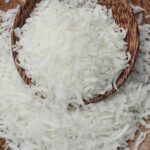
Desiccated coconut is produced by shredding, drying, and grading fresh coconut meat. In its natural state, coconut meat contains roughly 60–70% fat, most of it saturated fat in the form of medium-chain triglycerides. Regular (high-fat) desiccated coconut retains this natural oil content because the meat is simply dried, not processed further.
Low-fat desiccated coconut is produced by mechanically pressing shredded coconut meat to extract a portion of the natural oil before drying. This is a physical, not chemical, process — no solvents are used in food-grade production — but it changes the composition significantly, typically bringing fat content down to 10–25% depending on how much oil is extracted.
Regular desiccated coconut, sometimes labelled full-fat, is the default grade most buyers picture when they think of the ingredient. It carries the coconut’s natural richness, releases oil when heated, and contributes directly to moisture and tenderness in baked goods.
The trade-off is oxidative stability. Higher oil content means higher exposure to rancidity risk over time, particularly in warm or humid storage conditions, which makes packaging and shelf-life management more important for high-fat grades.
Low-fat desiccated coconut retains coconut flavour and fibre while reducing the oil fraction, which changes how it behaves in a formulation and extends shelf stability.
The trade-off runs in the opposite direction: because low-fat desiccated coconut has had oil mechanically removed, it can taste and feel drier, and it will not contribute the same richness or moisture to baked applications as the high-fat grade.
| Parameter | Low-Fat Desiccated Coconut | High-Fat (Regular) Desiccated Coconut |
|---|---|---|
| Typical fat content | 10–25% | 60–70% |
| Flavour intensity | Milder | Rich, full coconut flavour |
| Texture | Drier, more fibrous | Moist, tender |
| Oxidative stability | Higher — lower rancidity risk | Lower — needs careful storage |
| Best fit | Health snacks, dry mixes, export shipments | Bakery, confectionery, indulgent snacks |
| Shelf life (sealed, ambient) | 12–18 months | 9–12 months |
| Step | Action |
|---|---|
| 1 | Check your nutrition panel targets — low-fat grade helps if you need to reduce fat or saturated fat per serving |
| 2 | Consider your process — dry mixes and extrusion often favour low-fat grade for better flow and lower clumping |
| 3 | Evaluate shelf-life needs — long export routes or ambient storage favour the more stable low-fat grade |
| 4 | Weigh flavour and mouthfeel requirements — indulgent bakery and confectionery applications usually need the high-fat grade |
| 5 | Request a Certificate of Analysis (COA) confirming actual fat content for the specific batch, not just the grade name |
When comparing low-fat vs high-fat desiccated coconut from different suppliers, fat content is not always obvious from packaging alone, and grade naming is not fully standardised across the industry. Before committing to a bulk order, request a Certificate of Analysis (COA) showing fat content by weight, along with moisture and particle size specifications. According to the Food and Agriculture Organization (FAO), consistent specification verification is one of the most effective ways buyers reduce quality disputes in tropical commodity trade.
No. Low-fat and high-fat desiccated coconut come from the same coconut meat. The difference comes entirely from processing — low-fat grade has a portion of its natural oil mechanically pressed out before drying, while high-fat (regular) grade is dried without oil extraction.
Yes, to a noticeable degree. Because much of coconut’s flavour and aroma is carried in its oil, low-fat desiccated coconut has a milder, drier taste compared to the rich, rounded flavour of the high-fat grade. Many manufacturers compensate by adjusting formulation ratios or pairing it with complementary flavours.
Not always on a 1:1 basis. In applications where the coconut’s oil contributes to moisture, browning, or binding — such as macaroons or coconut cake — a direct substitution can dry out the final product. Trial batches are recommended before switching grades in an existing formulation.
Specify a numeric range rather than a grade name alone — for example, “fat content 15–20% by weight” for low-fat grade or “fat content 62–68% by weight” for regular grade — and request COA confirmation for every shipment. This avoids ambiguity between suppliers who may define “low-fat” differently.
Low-fat vs high-fat desiccated coconut is ultimately a formulation decision, not a quality judgement — neither grade is universally “better.” High-fat desiccated coconut delivers the rich flavour and moisture that bakery and confectionery applications rely on, while low-fat desiccated coconut supports cleaner nutrition panels, better flow in dry mixes, and longer shelf stability for export. Matching the grade to your product’s function is what determines whether the ingredient performs the way your formulation team expects.
At Abimex Group, we supply both low-fat and high-fat desiccated coconut from Vietnam, with batch-specific COA confirming fat content, moisture, and particle size for every shipment — Halal, Kosher, and FSSC 22000 certified.
Contact us to request samples or a technical specification sheet for either grade.