CASHEW NUT SHELL OIL

CASHEW NUT SHELL OIL
RICE PROTEIN POWDER
RICE PROTEIN POWDER
DESICCATED COCONUT
Jackfruit chips vs potato chips may seem like a simple comparison between two crunchy snacks, but the differences begin long before either product reaches the snack aisle. One starts with tropical fruit flesh, while the other is made from a starchy root vegetable. Their natural structures, processing behavior, flavor, shape, and crunch can therefore be noticeably different.
For snack brands, importers, distributors, and consumers exploring new product categories, understanding these differences can help explain why jackfruit chips are increasingly appearing alongside more traditional snacks.
One point requires particular care: nutritional values can vary considerably between products depending on raw material, frying method, oil, seasoning, formulation, and serving size. Therefore, this comparison focuses on general product characteristics rather than claiming that one snack is nutritionally superior to the other.
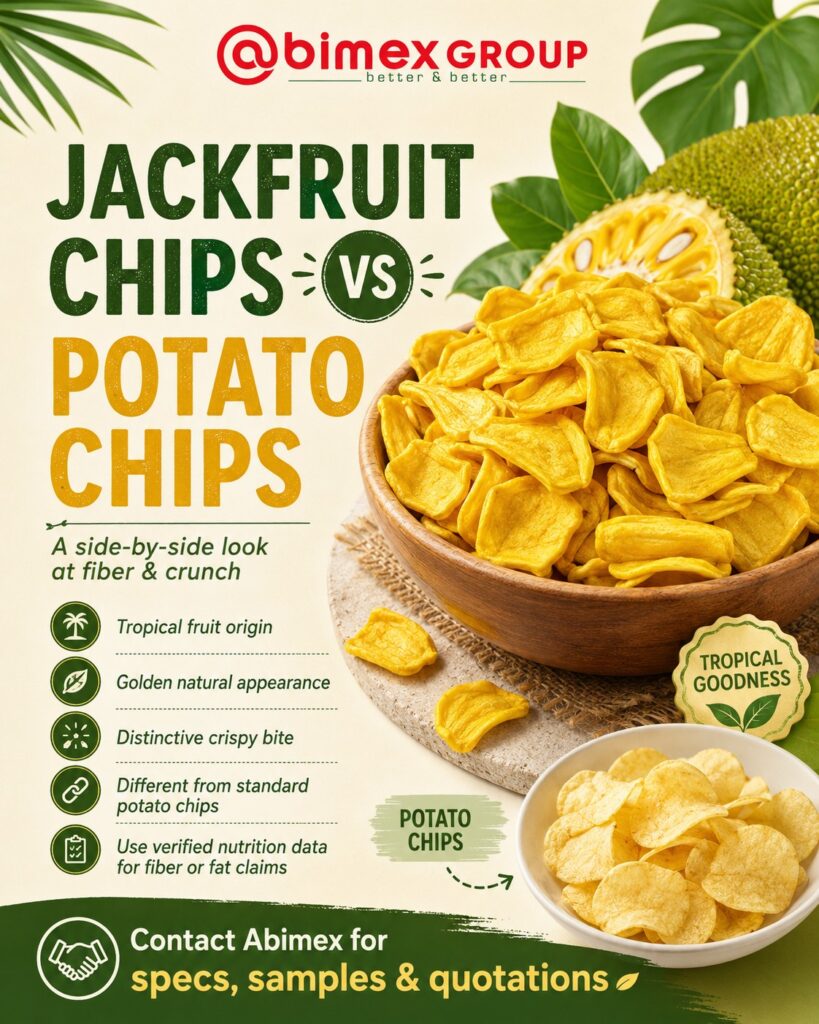
Table of Contents
ToggleThe most obvious difference is the ingredient itself.
Potato chips are usually made from potatoes that are washed, peeled when required, sliced relatively thinly, cooked, and seasoned.
Jackfruit chips begin with jackfruit flesh.
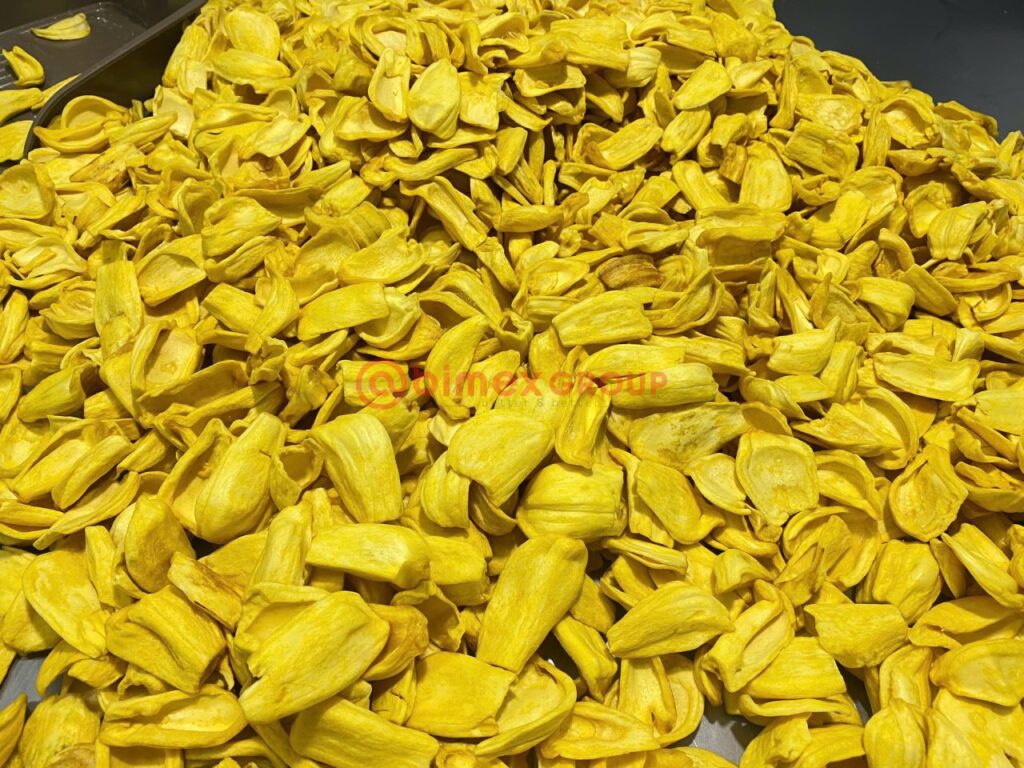
Jackfruit has naturally formed fruit bulbs with a fibrous internal structure. After preparation, the edible pieces can be processed into a crispy snack while maintaining shapes that still resemble sections of the original fruit.
This creates a very different visual experience.
Potato chips are usually thin and relatively uniform.
Jackfruit chips often have:
For snack brands looking for a product that visually communicates its tropical fruit origin, this distinction can be important.
When discussing jackfruit chips vs potato chips, the word “fiber” can refer to two different things.
The first is physical fruit structure.
Jackfruit flesh visibly contains fibrous plant tissue. This structure contributes to the appearance and bite of the finished chips.
The second is dietary fiber, which is a nutritional measurement.
These should not be treated as the same thing.
It would be inaccurate to assume that jackfruit chips automatically contain more dietary fiber than a specific potato chip product simply because the fruit looks fibrous.
Actual dietary fiber content depends on the finished formulation and processing conditions and should be confirmed through reliable nutrition data or laboratory analysis.
For commercial buyers, the product’s Nutrition Facts, specification sheet, or laboratory test results should be used when a numerical fiber comparison is required.
The original structure of jackfruit remains relevant even after processing.
Unlike a uniformly sliced potato, a jackfruit bulb contains different layers and natural fibers.
After frying and moisture removal, these structures can create a crunch that feels less uniform than a conventional potato chip.
One part of a jackfruit chip may be thinner and break quickly, while another may have a slightly thicker, more substantial bite.
This variation is part of the sensory identity of jackfruit chips vs potato chips.
Potato chips, particularly commercially sliced products, are usually designed for relatively predictable thickness and crunch.
Jackfruit chips offer a more irregular fruit-based structure.
Neither experience is universally better; they simply serve different consumer expectations.
Crunch is one of the most important characteristics of any chip product.
Conventional potato chips are usually thinly sliced and fried or baked until sufficient moisture has been removed.
Their thin geometry helps create a crisp structure that breaks quickly when bitten.
Depending on thickness and processing style, potato chips may range from light and delicate to thick and kettle-style.
Jackfruit chips typically retain the natural shape of fruit pieces rather than being cut into extremely thin, flat slices.
When properly processed, moisture removal creates a dry, crispy structure.
The resulting crunch can feel:
For vacuum-fried products, manufacturers can process jackfruit under reduced pressure, allowing water to evaporate at lower temperatures than conventional atmospheric frying.
The exact texture still depends on the fruit, maturity, piece size, process, final moisture, and packaging.
Whether the product is jackfruit or potato, maintaining crispness depends heavily on moisture.
A crispy structure requires sufficiently low available moisture.
If chips absorb humidity during storage, their texture may change.
They may become:
This is why packaging is a major part of the jackfruit chips vs potato chips discussion.
The frying process can create excellent texture, but poor moisture protection after production can undermine it.
Manufacturers therefore need packaging with appropriate barrier properties and reliable seals.
For long-distance export shipments, this becomes even more important because products may experience changing temperature and humidity conditions.
Many jackfruit chips are produced using vacuum frying.
Vacuum frying occurs under reduced pressure. Because the boiling point of water decreases under lower pressure, moisture can be removed at lower processing temperatures than in standard atmospheric frying.
For jackfruit, this process can help manufacturers maintain characteristics such as:
Potato chips can be produced using multiple technologies, including conventional frying, vacuum frying, baking, or other industrial processes.
Therefore, it is better to compare the actual manufacturing method rather than assume all potato chips are processed identically.
Processing technology also should not automatically be translated into a health claim.
For example, describing a product as vacuum-fried does not by itself prove that it contains fewer calories or less fat than another snack.
Those claims require product-specific nutritional data.
Another clear difference between jackfruit chips vs potato chips is flavor.
Potatoes have a relatively mild base flavor.
This allows manufacturers to develop a huge range of seasoning profiles, including:
Jackfruit has a more recognizable fruit flavor.
Even after processing, quality jackfruit chips may retain characteristic tropical aroma and flavor notes.
Depending on the formulation, the snack may combine natural fruit sweetness with the roasted or fried characteristics created during processing.
This means jackfruit chips can often be enjoyed with relatively simple seasoning because the raw material itself contributes noticeable flavor.
For tropical snack brands, this can be an advantage.
Classic potato chips usually range from pale yellow to golden brown depending on potato variety and processing conditions.
Jackfruit naturally has yellow to deep golden flesh.
Manufacturers of crispy jackfruit chips often aim to maintain this recognizable tropical color.
Several factors can influence final appearance:
Vacuum frying can be useful where manufacturers want to limit excessive browning and retain a brighter fruit appearance.
However, some natural color variation should be expected because jackfruit is an agricultural raw material.
Potato chips can often be produced with considerable dimensional consistency because potatoes can be mechanically sliced to a controlled thickness.
Jackfruit does not behave in exactly the same way.
Individual fruit bulbs naturally vary in size and shape.
As a result, a bag of jackfruit chips may contain pieces with somewhat different:
For buyers accustomed to highly standardized snacks, this natural variation needs to be understood.
Quality control should focus on reasonable tolerances rather than expecting every fruit piece to be identical.
For private-label brands, specifications can be developed around acceptable piece size, broken-piece ratio, color, and texture.
Both jackfruit chips and potato chips may involve frying oil depending on the manufacturing method.
It would therefore be misleading to assume that fruit chips are automatically low in fat.
Final oil content can be influenced by:
Vacuum-fried products may also undergo centrifugal oil-removal steps after frying.
However, if a buyer wants to compare fat levels between jackfruit chips vs potato chips, actual Nutrition Facts or laboratory results should be used.
The category name alone is not enough.
This question often appears when comparing fruit snacks with conventional chips.
The correct answer is: it depends on the specific products being compared.
Jackfruit naturally contains plant fiber, and potatoes also contain dietary fiber.
Processing and formulation affect the final nutritional composition per serving.
In addition, commercial products can differ in:
Therefore, any statement such as “jackfruit chips contain more fiber than potato chips” should be supported by verified nutrition information from the two specific products.
For marketing purposes, it is safer to describe jackfruit as a fruit-based snack with a naturally recognizable fibrous structure unless quantitative dietary-fiber data is available.
The strongest argument for jackfruit chips does not need to rely on a nutrition comparison.
Jackfruit chips offer something genuinely different.
They provide:
A tropical raw material – Jackfruit remains less conventional than potatoes in many international snack markets.
Distinctive appearance – Pieces retain recognizable fruit shapes.
Characteristic flavor – Jackfruit contributes its own aroma and flavor profile.
Different crunch – The natural fruit structure creates a different bite from thin potato slices.
Product differentiation – Brands can expand beyond traditional chip categories.
This positioning is more defensible than trying to present jackfruit chips as a direct nutritional replacement for potato chips.
Potato chips are one of the world’s most established snack formats.
Jackfruit chips do not necessarily need to compete with them directly.
Instead, they can occupy a different space.
Potential categories include:
For retailers, adding jackfruit chips can increase variety without removing familiar potato-based products.
For snack brands, the product can help create a more distinctive portfolio.
International retailers and snack companies are increasingly interested in differentiated private-label products.
Jackfruit chips can be sold in bulk or packaged into branded retail formats depending on supplier capabilities.
Private-label projects may involve decisions about:
However, buyers should check packaging minimum order quantities early in the project.
Custom-printed packaging can require significantly larger quantities than the initial commercial order.
This is an operational detail that is easy to overlook when developing a new snack line.
When comparing suppliers, buyers should evaluate the actual product rather than relying only on marketing descriptions.
Important characteristics include:
For larger orders, technical specifications become increasingly important.
Commercial buyers may also review:
A representative sample can provide a useful benchmark before commercial production begins.
There is no universal winner.
Potato chips offer a highly familiar flavor, standardized shape, and enormous variety of seasoning options.
Jackfruit chips offer a more distinctive tropical experience, natural variation in shape, recognizable fruit character, and a different type of crunch.
From a nutritional perspective, neither product should automatically be described as superior without comparing verified product-specific data.
From a product-development perspective, however, jackfruit chips provide a useful way for brands to diversify their snack portfolio.
The more useful question is therefore not:
“Which chip is healthier?”
but rather:
“Which snack experience fits the target consumer and market positioning?”
The comparison of jackfruit chips vs potato chips highlights how strongly raw material influences the final snack.
Potatoes provide a relatively uniform base that can be sliced thinly and seasoned in countless ways.
Jackfruit provides a naturally fibrous tropical fruit structure that can produce irregular golden pieces with a distinctive crunch and recognizable flavor.
Both can deliver crispy snack experiences, but they do so differently.
For commercial buyers, the best way to make a meaningful comparison is to evaluate actual samples and verified technical or nutritional information rather than relying on assumptions based on the ingredient category.
Abimex Group supplies Vietnamese crispy jackfruit chips for international importers, distributors, retailers, snack manufacturers, and private-label projects.
Buyers can discuss product specifications, bulk packing, retail packaging, OEM/private-label requirements, samples, and available export documentation according to project needs.
For nutritional comparisons or specific product claims, we recommend using verified data for the actual product and target market.