CASHEW NUT SHELL OIL

CASHEW NUT SHELL OIL
RICE PROTEIN POWDER
RICE PROTEIN POWDER
DESICCATED COCONUT
Vietnamese tapioca starch begins its journey long before it reaches a food factory, paper mill, textile manufacturer, or industrial user. The process starts in cassava-growing regions, where fresh roots are cultivated, harvested, and transported to processing facilities before being transformed into the fine white starch used in a wide range of applications.
For international buyers, understanding this general production journey can provide useful insight into the factors that influence starch consistency, cleanliness, moisture, viscosity, and overall product quality.
While individual factories may use different equipment and proprietary processing parameters, the basic production flow of tapioca starch follows several common stages.
This article provides a general overview of how cassava roots become export-ready tapioca starch in Vietnam.
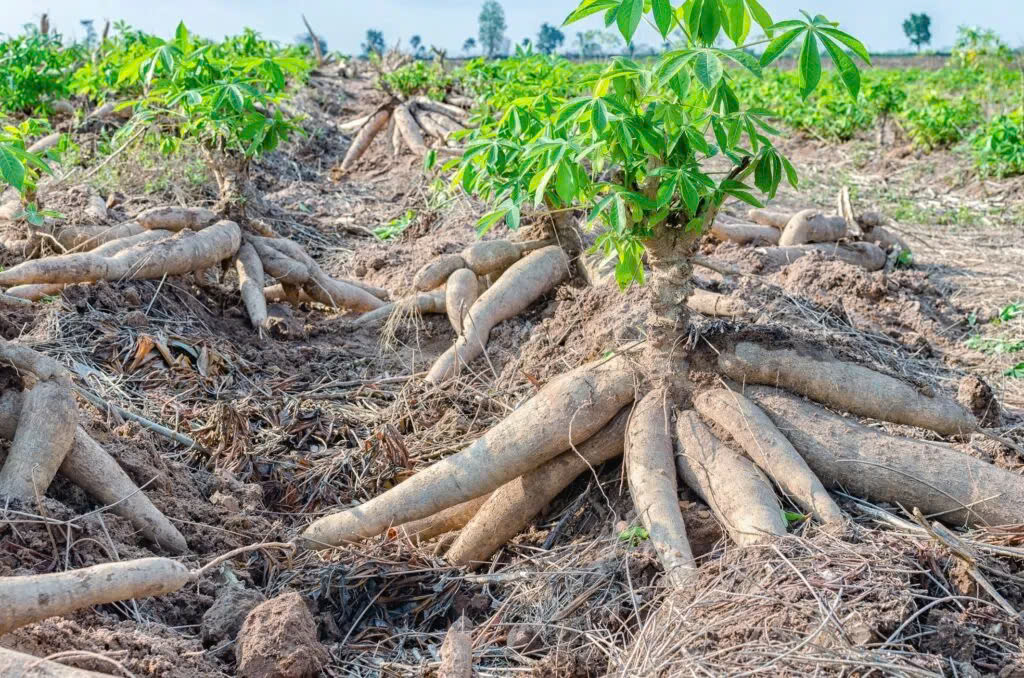
Table of Contents
ToggleThe production of Vietnamese tapioca starch begins with cassava, also known as manioc or yuca.
Cassava is a tropical root crop well suited to the climate and agricultural conditions found in many parts of Vietnam. Farmers cultivate cassava for several months before the roots reach the maturity required for harvesting.
The quality of the raw material can influence the performance of the final starch.
Factors that may affect cassava quality include:
Processors therefore need to manage raw-material sourcing carefully to maintain consistent production.
Cassava roots contain significant amounts of starch, but they also contain water, fiber, peel, soil, and other natural components that need to be separated during processing.
Once cassava reaches the appropriate stage of maturity, the roots are harvested from the field.
Unlike some dry agricultural commodities, fresh cassava roots are relatively perishable after harvesting.
For this reason, transportation time from farm to factory is an important operational consideration.
Roots are generally transported to processing facilities as soon as practical after harvest.
At this stage, factories may inspect incoming raw materials based on criteria such as:
The objective is to begin processing with suitable raw material before quality deterioration becomes significant.
For buyers of Vietnamese tapioca starch, this early stage matters because starch production quality is closely connected to raw-material handling.
Fresh cassava roots arrive at the factory with soil, sand, peel residues, and other materials from harvesting and transportation.
The first processing stages therefore focus on cleaning.
Cassava roots typically pass through equipment designed to remove loose soil and unwanted materials.
They are then washed with water to further clean the surface.
Depending on the factory design, washing may involve rotating drums, washing channels, paddles, or other mechanical systems.
The purpose is straightforward: remove as much external contamination as possible before the roots enter the starch extraction process.
Effective washing helps support the cleanliness and appearance of the final Vietnamese tapioca starch.
After washing, the cleaned cassava roots need to be broken down.
Cassava starch is stored inside the cells of the root tissue.
To release it efficiently, processors mechanically reduce the roots into much smaller particles.
This may involve rasping, grinding, or similar mechanical size-reduction methods.
The process breaks open the plant tissue and produces a mixture containing:
At this point, the product still looks very different from the fine white starch powder sold commercially.
Several separation stages are still required.
Once the cassava root structure has been broken down, the next goal is to separate the starch from the fibrous material.
The mixture is normally combined with water and passed through screening or separation equipment.
Because starch particles are much smaller than many fibrous components, mechanical separation allows a starch-rich liquid to pass through while larger fibers are removed.
Factories may use multiple separation stages to improve starch recovery and cleanliness.
The exact equipment configuration varies between processing plants.
However, the general objective remains the same: separate the starch fraction from the non-starch components of the cassava root.
After the larger fibers have been removed, the starch is still suspended in water.
This liquid mixture is often referred to as a starch slurry or starch milk.
Additional separation and purification steps are then used to remove remaining fine impurities.
Depending on factory technology, this may involve systems based on centrifugal force or other physical separation principles.
The objective is to increase the concentration and purity of the starch while reducing unwanted solids.
This purification stage is especially important because the commercial value of Vietnamese tapioca starch depends heavily on consistency.
Buyers often evaluate parameters such as:
Proper separation and purification support the ability of the manufacturer to meet these specifications consistently.
At this stage, the purified starch is still mixed with a significant amount of water.
Before drying, processors normally remove part of this water mechanically.
This produces a wet starch cake with a much higher solids concentration than the original slurry.
Mechanical dewatering is useful because removing water before thermal drying can make the overall drying process more efficient.
The resulting wet starch cake is then prepared for the drying stage.
Drying is one of the most important steps in producing commercial Vietnamese tapioca starch.
The wet starch needs to be converted into a stable, free-flowing powder with controlled moisture.
Industrial starch factories typically use continuous drying systems that expose the wet starch to controlled heated air.
Water evaporates rapidly, leaving behind dry starch particles.
The exact temperature, airflow, residence time, and equipment design depend on the individual factory and are normally part of the manufacturer’s production know-how.
The general objective is to reach the required moisture specification without negatively affecting product quality.
Moisture control is important because excessive moisture can affect:
At the same time, drying conditions need to be carefully controlled to maintain the desired starch functionality.
After drying, tapioca starch may pass through sieving or classification equipment.
This helps create a more uniform powder and remove unwanted oversized particles.
The finished starch is generally a fine white powder with a neutral appearance.
Depending on the intended application, customers may have specific expectations regarding particle characteristics, viscosity, whiteness, and other technical parameters.
Maintaining uniformity from batch to batch is particularly important for industrial users.
A sauce manufacturer, paper producer, adhesive manufacturer, or textile processor needs raw materials that perform consistently in production.
This is why final product control is an important part of the Vietnamese tapioca starch supply chain.
Before tapioca starch is released for commercial sale, manufacturers typically perform quality-control checks.
The exact testing program depends on the factory, product grade, application, and customer requirements.
Common parameters may include:
For food-grade starch, additional food safety controls may also apply.
Industrial customers may place greater emphasis on functional characteristics relevant to their own applications.
A Certificate of Analysis may be issued for individual production batches depending on the supplier’s quality system and commercial arrangement.
Once the product meets the required specification, the finished starch is packed.
Common bulk packaging formats may include multi-layer bags suitable for industrial handling and transport.
The actual bag size and material depend on buyer requirements and the intended market.
For export orders, packaging also needs to withstand:
Proper sealing and storage conditions help protect the starch against moisture and contamination.
Palletization may also be used depending on the buyer, destination, and shipping arrangement.
Finished Vietnamese tapioca starch is stored under suitable warehouse conditions before shipment.
Starch should generally be protected from moisture, strong odors, pests, and contamination.
For international orders, the supplier and buyer also need to prepare the required shipping documentation.
Depending on the destination and commercial agreement, documents may include:
Specific requirements vary between markets, so importers should confirm documentation needs before shipment.
The factory process is important, but the supply chain begins at the farm.
Fresh cassava quality can affect extraction efficiency and final starch characteristics.
For this reason, starch manufacturers often pay close attention to raw-material procurement, harvest conditions, transportation time, and incoming inspection.
A consistent supply of suitable cassava roots helps create a more stable production process.
This connection between agriculture and industrial processing is one of the defining characteristics of the Vietnamese tapioca starch industry.
The process described above primarily explains the production of native tapioca starch.
Native starch can then serve as a raw material for further processing into different modified starch grades.
Modified tapioca starch is designed to provide specific functional properties for applications where native starch may not perform sufficiently under demanding conditions.
Depending on the grade, modified starch may be developed for applications involving:
The production of modified starch involves additional processing beyond standard native starch extraction.
Because modification technologies and operating conditions can be proprietary, manufacturers generally provide customers with technical specifications rather than detailed process parameters.
Tapioca starch is used across a wide range of industries.
Applications may include:
Starch may be used in paper manufacturing and surface treatment applications.
Tapioca starch and modified starch can be used in selected textile-processing applications.
Starch-based systems are used in certain paper, packaging, and industrial adhesive formulations.
Different native and modified starch grades may also be used in construction materials, biodegradable products, and other industrial formulations.
The suitable starch depends on the customer’s processing conditions and technical requirements.
When sourcing Vietnamese tapioca starch, international buyers should look beyond price alone.
Important factors to evaluate include:
For applications where viscosity or processing stability is particularly important, buyers should test representative samples under their own production conditions.
A starch that works well in one formulation may perform differently in another.
The journey of Vietnamese tapioca starch connects agriculture with modern industrial processing.
Cassava begins as a fresh root grown in the field. After harvesting, it moves through cleaning, size reduction, starch extraction, purification, dewatering, drying, sieving, quality control, packaging, and distribution.
Each stage contributes to the consistency of the final starch.
While individual manufacturers may use different equipment and proprietary production parameters, understanding this general process helps buyers evaluate suppliers more effectively and communicate technical requirements more clearly.
Abimex Group supplies Vietnamese native and modified tapioca starch for international distributors, food manufacturers, and industrial customers.
Our team can support customers with product specifications, samples, packaging information, available technical documentation, and quotations based on application requirements.
Different tapioca starch grades may be suitable for different food and industrial applications, so buyers are encouraged to provide their target specification and processing requirements for evaluation.