CASHEW NUT SHELL OIL

CASHEW NUT SHELL OIL
RICE PROTEIN POWDER
RICE PROTEIN POWDER
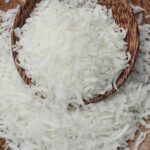
DESICCATED COCONUT
Desiccated coconut in high-moisture foods can behave very differently from the same ingredient used in dry applications such as toppings, coatings, granola, or snack mixes. Once desiccated coconut comes into contact with water-rich ingredients, it may gradually absorb moisture, soften, swell, and change the overall texture of the finished product.
For food manufacturers, product developers, and B2B buyers, this matters because an ingredient that performs well in one formulation may create a very different sensory experience in another.
The final result depends on several factors, including particle size, fat content, moisture level, formulation, processing conditions, contact time, and storage environment. Understanding these variables can help buyers select a more suitable specification for their intended application.
Table of Contents
ToggleDesiccated coconut is produced by reducing much of the water naturally present in coconut meat. Because of this, the dried coconut structure can interact with moisture again when it is incorporated into wetter foods.
The key reason desiccated coconut in high-moisture foods changes over time is moisture migration. Water from surrounding ingredients may move into the coconut particles until the system reaches a new balance.
This can affect softness, chewiness, particle size, mouthfeel, and how clearly the coconut remains visible in the finished product.
However, the degree of change is not the same in every application. A coconut particle in a moist cake filling may behave differently from one in a chilled dessert, sauce, confectionery center, or dairy-free product.
One of the most noticeable effects is softening.
When dry coconut particles absorb moisture from the surrounding food, they can become more flexible and less crisp or fibrous. This may be desirable in some products, especially when manufacturers want a softer, more integrated texture.
In other applications, too much hydration may reduce the distinct coconut bite that the developer intended.
For example, a formulation designed to provide visible coconut texture may require careful consideration of how much moisture is available and how long the coconut remains in contact with the other ingredients.
This is why the performance of desiccated coconut in high-moisture foods should ideally be evaluated over the expected product life rather than only immediately after production.
A product that feels right on day one may develop a different texture after continued moisture migration.
Fine, medium, and larger coconut particles do not always behave in the same way.
Smaller particles generally have more surface area relative to their size, which can influence how quickly they interact with surrounding moisture. They may blend more easily into a formulation and create a smoother, more uniform eating experience.
Larger particles, on the other hand, may remain more visible and provide a stronger coconut texture.
This makes cut size an important specification for food manufacturers.
When using desiccated coconut in high-moisture foods, the decision between fine and medium grades should be based on the desired final product rather than simply on availability.
A fine grade may work well when coconut needs to become part of the overall texture, while a larger cut may be more suitable when visible pieces and a noticeable bite are part of the product concept.
Texture changes do not always happen immediately.
Desiccated coconut may continue absorbing moisture after mixing, filling, packaging, and storage. As a result, the texture experienced by the consumer can be different from what is observed during production.
This is especially important for products with longer storage periods.
Product developers may therefore need to evaluate the formulation at multiple points rather than relying on a single fresh-production sample.
For example, coconut used in a moist filling may gradually soften as the product sits. In another formulation, the coconut may remain relatively distinct because less free moisture is available.
The relationship between moisture and time is one reason formulation testing is important before commercial-scale production.
Desiccated coconut naturally contains coconut fat, although commercial specifications may vary.
Fat content can contribute to richness, aroma, and mouthfeel, particularly in desserts, confectionery, bakery fillings, and plant-based products.
When coconut becomes hydrated, the interaction between fiber, moisture, and fat can influence how the ingredient feels in the mouth.
For B2B buyers, this means particle size should not be the only specification considered. Fat content, moisture, aroma, and other quality characteristics may also influence the final sensory experience.
When evaluating desiccated coconut in high-moisture foods, manufacturers should look at the complete ingredient specification rather than focusing on a single parameter.
Not all high-moisture foods contain the same type or amount of available water.
Sugar, starches, proteins, fats, stabilizers, and other ingredients can influence how water behaves within a product.
This means two products with similar total moisture levels may not necessarily affect desiccated coconut in exactly the same way.
A sweet filling, for example, may create a different hydration environment from a savory sauce or a chilled dessert.
Processing conditions can also matter. Mixing intensity, heating, cooling, and storage temperature may influence how quickly the coconut interacts with surrounding ingredients.
For this reason, there is no single rule that predicts exactly how coconut will perform in every wet formulation.
High-moisture applications can include a wide range of product types, from bakery fillings and dessert cups to dairy-free concepts and confectionery centers.
In each case, manufacturers may want something different from the coconut ingredient.
A bakery filling may need coconut that becomes soft without disappearing into the mixture. A dessert cup may require visible particles for texture and presentation. A confectionery center may need a more integrated coconut structure that remains pleasant to chew.
This is where desiccated coconut in high-moisture foods becomes a product-development question rather than simply an ingredient-purchasing decision.
The right specification should support the intended sensory experience.
The interaction between coconut and moisture does not stop once the product is packaged.
Temperature, packaging, storage duration, and moisture movement between different parts of the food can continue to affect texture.
In multi-component products, moisture may migrate from wetter components toward drier ones over time.
This may cause coconut particles to soften further or change how they interact with surrounding ingredients.
Packaging that helps maintain the intended product environment can therefore be part of the overall quality strategy.
For manufacturers working with desiccated coconut in high-moisture foods, shelf-life testing and supplier guidance can provide a clearer picture of how the ingredient performs under actual storage conditions.
Rather than selecting desiccated coconut based only on price or cut size, buyers may want to review the ingredient in the context of the final formulation.
Useful points to discuss with a supplier include:
Testing samples in the actual formulation can be especially useful because sensory performance cannot always be predicted from a specification sheet alone.
The behavior of desiccated coconut in high-moisture foods depends on the interaction between the ingredient and the surrounding formulation.
Moisture absorption, particle size, contact time, fat content, processing conditions, and storage can all influence whether coconut remains firm and noticeable or becomes softer and more integrated.
There is no single grade that is automatically best for every high-moisture application.
For food manufacturers, the most practical approach is to define the desired texture first and then select a coconut specification that supports that goal.
Abimex Group supports international B2B buyers sourcing desiccated coconut for bakery, confectionery, desserts, snacks, food manufacturing, and private-label applications.
Whether you are evaluating desiccated coconut in high-moisture foods or developing another coconut-based product, Abimex Group can support discussions around product specifications, cut sizes, packaging requirements, and export coordination.
Contact Abimex Group to discuss your application, required specifications, and sourcing needs for your target market.