CASHEW NUT SHELL OIL

CASHEW NUT SHELL OIL
RICE PROTEIN POWDER
RICE PROTEIN POWDER
DESICCATED COCONUT
Sulphite-free vs sulphited desiccated coconut is an important distinction for food manufacturers, importers, distributors, and private-label buyers.
Both products can be used in bakery, confectionery, snack, cereal, dessert, and ingredient applications, but they may differ in processing approach, residual sulphur dioxide level, labeling implications, color stability, and buyer acceptance.
For international trade, one of the most common mistakes is simply ordering “desiccated coconut” without clearly defining the required sulphite status.
A buyer may expect a product with no added sulphites, while the supplier may work to a conventional specification that permits residual SO₂.
This can lead to problems with:
For this reason, buyers should define sulphite requirements clearly before production begins.
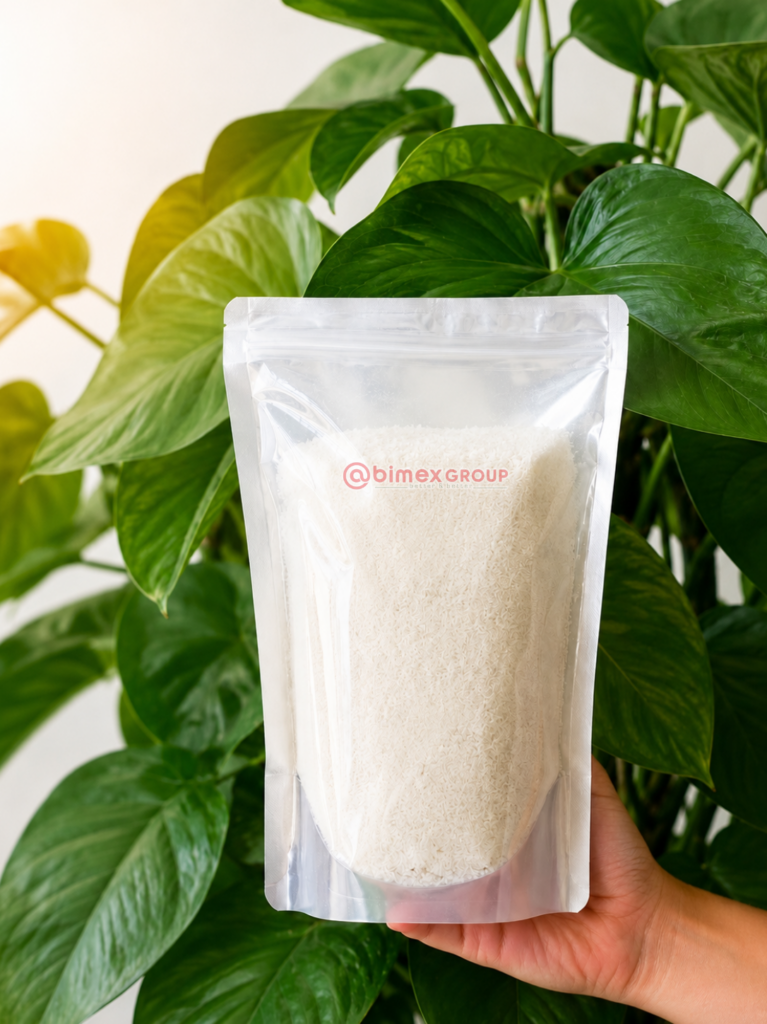
Table of Contents
ToggleSulphited desiccated coconut refers to coconut that has been processed using sulphur dioxide or sulphite-based treatment as part of the production process.
The purpose of such treatment may include supporting:
Depending on the process and specification, a measurable level of residual sulphur dioxide may remain in the finished product.
The actual level can vary according to:
For B2B buyers, the key issue is not simply whether sulphite was used, but what the final product specification allows.
The term sulphite-free desiccated coconut is commonly used commercially to describe a product manufactured without added sulphites.
However, buyers should define this term carefully.
“Sulphite-free” can sometimes be interpreted differently by different companies.
It may mean:
These are not automatically the same thing.
For international purchasing, the buyer should avoid relying only on the phrase “sulphite-free.”
Instead, the purchase specification should include a measurable SO₂ requirement whenever possible.
There are several reasons a customer may prefer sulphite-free material.
Some brands prefer simpler ingredient declarations and formulations.
A buyer may want to market a product with minimal processing aids or additives.
In these cases, sulphite-free coconut may better match the brand’s product positioning.
Large retailers and food manufacturers often have internal ingredient standards that are stricter than general legal requirements.
A retailer may request:
Suppliers should follow the buyer’s written specification rather than assume a general market standard is sufficient.
Sulphites are treated as an important labeling or sensitivity issue in a number of markets when present above applicable thresholds.
Because rules differ by destination, buyers need to confirm the relevant local requirements.
For export orders, it is safer to agree on:
before production.
Sulphite treatment may support visual and quality stability.
One of the main concerns in coconut processing is maintaining a clean, white appearance.
During processing and storage, coconut color can be influenced by:
Sulphite treatment can help control some of these changes.
This is why sulphited desiccated coconut may be preferred by buyers who place strong emphasis on bright color and appearance.
However, sulphite use must still comply with the relevant customer specification and destination-market rules.
Color is one of the most visible differences buyers may notice.
Sulphited desiccated coconut may show stronger resistance to discoloration under some conditions.
Sulphite-free coconut may be more dependent on:
That does not mean sulphite-free coconut must be darker or lower quality.
A well-controlled sulphite-free process can still produce attractive white or creamy-white desiccated coconut.
However, process control becomes especially important.
When used appropriately, sulphite treatment should not dominate the expected coconut flavor.
However, buyers evaluating sulphite-free vs sulphited desiccated coconut should still conduct sensory testing.
Important points include:
Sensory approval is particularly important for applications such as:
A technical COA alone cannot fully describe flavor quality.
For professional sourcing, sulphur dioxide should be treated as a defined specification parameter.
Instead of writing:
“Sulphite-free coconut required.”
A more precise purchasing document might state:
“No added sulphites. Residual SO₂ must comply with the agreed customer specification and destination-market requirements.”
Or, where the buyer has a defined numerical requirement:
“SO₂: maximum ___ ppm, tested by agreed method.”
This reduces ambiguity.
The exact limit should be supplied by the buyer based on:
Suppliers should not guess the acceptable value.
SO₂ test results can vary depending on laboratory method and sample handling.
For sensitive contracts, buyers should define:
This becomes especially important when the buyer has a very low SO₂ requirement.
A supplier and buyer can otherwise receive slightly different results from separate laboratories and interpret the same batch differently.
Another common misunderstanding is assuming that sulphite-free coconut will perform exactly the same as sulphited coconut under every storage condition.
Without sulphite treatment, quality preservation may rely more heavily on:
For buyers, this means packaging and logistics should be considered together with the sulphite specification.
Whether the product is sulphite-free or sulphited, packaging still plays an important role.
Desiccated coconut needs protection from:
Food-grade export packaging should be agreed before shipment.
For long-distance sea freight, container conditions also matter.
Poor storage or a wet container can damage good product regardless of sulphite status.
Sulphite status does not replace other quality parameters.
Buyers should continue to control moisture because excessive moisture can affect:
For this reason, a complete specification should include both:
SO₂ requirement + moisture requirement
rather than focusing on sulphite alone.
Desiccated coconut is commonly supplied in different fat categories.
Buyers may request:
Fat content influences:
A sulphite-free high-fat coconut and a sulphited lower-fat coconut are not equivalent products.
The specification should define all major parameters separately.
Sulphite should not be treated as a substitute for food-safety controls.
Buyers should still review microbiological specifications, which may include parameters such as:
Requirements vary by market and end user.
A sulphited product should not automatically be assumed to have better microbiological quality.
Food safety depends on the entire manufacturing system.
When ordering sulphite-free vs sulphited desiccated coconut, the cut should also be clearly defined.
Common grades include:
Fine grade may be selected for:
Medium grade may be selected when buyers want:
Particle-size distribution should be included where important.
A good purchase order should be specific enough to prevent different interpretations.
A B2B order for desiccated coconut may specify:
This is much more reliable than simply ordering:
“1 container desiccated coconut fine.”
A buyer specification could be structured as follows:
Product: Desiccated Coconut High Fat Fine
Sulphite Status: No added sulphites / sulphited, as required
SO₂ Requirement: According to agreed buyer specification
Moisture: According to agreed specification
Fat: According to agreed grade
Microbiology: According to buyer and destination-market limits
Packaging: Food-grade export packaging
Documentation: COA and required certificates
This format makes the commercial and technical requirements easier to manage.
There is no universal answer.
Sulphite-free desiccated coconut may be suitable when the buyer prioritizes:
Sulphited desiccated coconut may be suitable when the application permits sulphite and the buyer values additional support for color preservation and process stability.
The correct decision depends on:
The most important point is that the requirement should be agreed before production.
Buyers should avoid several common errors.
Different suppliers may interpret the term differently.
Labeling and SO₂ requirements should be confirmed before the order is manufactured.
For low limits, testing methodology can become commercially important.
Moisture, fat, microbiology, FFA, peroxide value, particle size, color, and flavor also matter.
Export requirements differ.
A specification accepted in one country may not automatically satisfy another.
Buyers should request representative samples before confirming a commercial shipment.
Samples can be evaluated for:
If SO₂ is critical, laboratory testing can also be requested.
For large contracts, buyers may consider verifying more than one production batch.
This helps evaluate consistency rather than relying on a single sample.
Good sourcing depends on clear communication between:
If the buyer requires a special sulphite specification, it should be communicated early.
Last-minute changes after production can lead to:
Clear written specifications reduce these risks.
The difference between sulphite-free vs sulphited desiccated coconut is not simply a marketing distinction.
It can affect:
Sulphite-free coconut is commonly selected when buyers want no added sulphites or need to meet a specific customer requirement.
Sulphited coconut may be selected where sulphite use is permitted and color stability is an important consideration.
Neither option should be treated as automatically superior.
For B2B buyers, the most important step is to define the requirement clearly.
Before placing an order, confirm:
A clear purchase specification protects both buyer and supplier and helps reduce disputes after shipment.
Abimex Group supplies Vietnamese desiccated coconut for international food manufacturers, importers, distributors, bakery companies, confectionery producers, and other B2B customers.
Different specifications can be discussed according to buyer requirements, including:
Buyers can request product specifications, samples, available certificates, batch documentation, and quotations.