
CASHEW NUT SHELL OIL

For food manufacturers, the phrase modified tapioca starch e number can quickly become confusing.
Buyers may see codes such as:
on specifications, ingredient declarations, product development documents or customer requests.
These codes do not all describe the same starch.
Each refers to a different type of modified starch, created to provide particular functional characteristics in food processing.
Codex lists modified starches under its International Numbering System, while EU legislation identifies corresponding E-numbers and conditions of use. For example, E1404 is oxidised starch, E1412 is distarch phosphate, E1414 is acetylated distarch phosphate, E1422 is acetylated distarch adipate and E1442 is hydroxypropyl distarch phosphate.
For B2B buyers, however, the E-number is only the starting point.
Two commercial starch grades within the same broad category may still perform differently depending on:
That is why buyers should always review the actual product specification and run application trials before approving a starch.
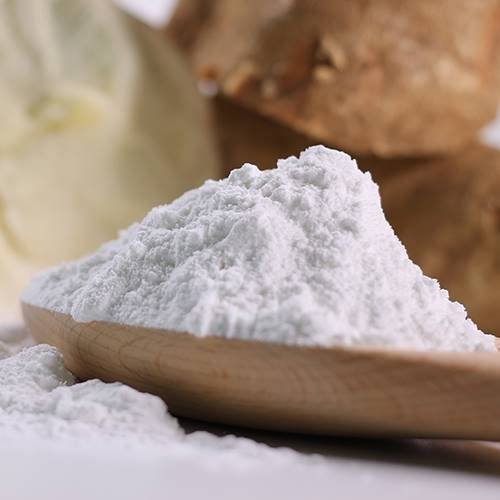
An E-number identifies an approved food additive category used in the European system.
For modified starches, the number indicates the type of chemical modification applied to the starch.
Codex also uses corresponding INS numbers for these modified starches.
The modification is designed to change how starch behaves during food processing.
Depending on the specific type and grade, manufacturers may be looking for properties such as:
These are general functional objectives rather than guaranteed characteristics for every commercial grade.
E1404 is oxidised starch.
Codex includes oxidised starch among modified starches and lists functions such as thickening, binding, emulsifying and stabilising.
In food systems, E1404 may be considered where manufacturers need controlled starch functionality combined with relatively smooth texture or processing convenience.
Potential applications can include certain:
The exact behavior depends on the commercial grade.
Manufacturers should not assume that every E1404 product has identical viscosity, gel strength or process tolerance.
Modified tapioca starch 1412, or E1412, is distarch phosphate.
This is a cross-linked starch type.
Cross-linking can help reinforce the starch structure, which is why this category is often considered for food processes involving more demanding conditions.
Codex identifies E1412 as distarch phosphate, while EU regulations also list E1412 as an authorised modified starch category.
Depending on the grade, manufacturers may investigate E1412 for applications requiring:
Potential applications can include:
However, buyers should verify the actual factory specification before claiming specific heat, shear or acid resistance.
E1414 is acetylated distarch phosphate.
This modification combines cross-linking with acetylation.
From a food formulation perspective, the purpose is generally to create a starch with a different balance of stability, texture and water interaction compared with native starch.
EU legislation and Codex both identify E1414 under this name.
Depending on the commercial grade, E1414 may be evaluated in applications such as:
The acetylated component may help influence texture and storage behavior, while cross-linking may support processing tolerance.
Still, the exact performance must come from the supplier’s technical documentation and application trials.
E1422 is acetylated distarch adipate.
This is one of the more commonly discussed modified starch categories in processed foods.
It is listed by both Codex and EU legislation as a modified starch additive.
Food manufacturers may consider E1422 when developing products where they need a combination of:
Potential application areas can include:
Certain commercial grades may also be developed for chilled or frozen systems, but freeze-thaw performance should never be assumed from the E-number alone.
For frozen applications, buyers should test the actual sample through realistic freeze-thaw cycles.
Modified tapioca starch 1442, or E1442, is hydroxypropyl distarch phosphate.
It combines cross-linking with hydroxypropyl modification.
This category is often considered in applications where manufacturers need a smooth, stable texture under demanding processing or storage conditions.
Codex identifies INS 1442 as hydroxypropyl distarch phosphate, and EU legislation lists the corresponding E1442.
Depending on the commercial grade, E1442 may be evaluated for:
Some grades may be designed to perform better under heat, shear, acidic conditions or freezing and thawing.
However, these characteristics should be confirmed from the technical data sheet rather than assumed simply because the product is E1442.
This is a common B2B question.
At a broad level:
E1412 is distarch phosphate.
E1442 is hydroxypropyl distarch phosphate.
Both are modified starches, but the type of modification differs.
That difference can affect how each commercial grade behaves in:
Therefore, the decision should not be:
“Which E-number is better?”
Instead, ask:
“Which grade gives the performance required in my formulation?”
A sauce manufacturer, frozen food producer and seafood processor may all require different starch behavior.
E1414 and E1422 are also frequently confused because both contain acetylated modifications.
However:
E1414 = Acetylated Distarch Phosphate
E1422 = Acetylated Distarch Adipate
They are different modified starch categories.
Their functionality may overlap in some applications, but they should not automatically be treated as interchangeable.
A direct substitution can change:
Application testing is essential.
The word modified can sometimes be misunderstood.
In this context, it means that starch has been physically, enzymatically or chemically treated to change functional properties.
It does not automatically tell you whether a starch is suitable for a particular food.
The important questions are:
For a broader comparison, buyers can also read:
Internal link: “Native vs Modified Tapioca Starch.”
That article can explain why native starch may be sufficient for some processes while modified starch is selected for more demanding conditions.
The search query “is modified tapioca starch bad for you” appears frequently because consumers often associate the word “modified” with safety concerns.
A neutral explanation is more appropriate.
The modified starch categories discussed here are recognised food additives under Codex and are included in EU food-additive legislation, subject to applicable food categories and conditions of use.
JECFA’s specifications for modified starches state that an ADI “not specified” was established for the listed modified starches, including E1404, E1412, E1414, E1422 and E1442.
In JECFA terminology, this does not mean manufacturers can use unlimited amounts without regard to regulations or good manufacturing practice.
It means the safety evaluation did not require a numerical ADI under the evaluated conditions.
In the EU, authorised food additives are subject to regulatory safety assessment and conditions of use, and additives used in foods must be identified appropriately on the ingredient list.
This article therefore does not make health claims.
Manufacturers should follow the regulatory requirements of the destination market.
No.
This is one of the most important points for B2B sourcing.
An E-number identifies the modification category, not every performance detail of the commercial product.
Two E1442 products, for example, may differ in:
This is why the factory TDS matters.
The correct sourcing sequence is:
E-number → Commercial grade → Technical specification → Sample test → Application approval.
Before approving modified tapioca starch, buyers should review the actual product documents.
Depending on the supplier and grade, relevant information may include:
The exact parameters should come from the factory specification.
Do not copy technical values from another supplier simply because the E-number is the same.
“HS code” is another common search associated with modified tapioca starch.
However, customs classification should not be determined from the E-number alone.
HS classification can depend on:
For export transactions, buyers and exporters should confirm the applicable HS code using the actual product documentation and relevant customs requirements.
An E-number and an HS code serve different purposes:
E-number = food additive identification
HS code = customs classification
They should not be treated as interchangeable.
A simple B2B approach is to start with the application.
Look at:
Evaluate:
Evaluate:
Evaluate:
Then select candidate grades and run application trials.
E-numbers help narrow the search, but they cannot replace practical testing.
Manufacturers should test the actual starch in the actual recipe.
A good evaluation may compare:
This is especially important when replacing an existing starch.
A one-to-one replacement is not guaranteed to produce identical results.
Abimex Group currently works with modified tapioca starch categories including:
Exact performance characteristics should always be matched to the factory specification for the selected commercial grade.
Before publishing application-specific technical claims, the relevant TDS should be reviewed.
There is no single E-number for all modified tapioca starch. Different modifications have different numbers, including E1404, E1412, E1414, E1422 and E1442.
E1442 is hydroxypropyl distarch phosphate, a modified starch category used in food applications where manufacturers may require controlled texture and processing or storage stability.
E1412 is distarch phosphate, a cross-linked modified starch category.
The modified starch categories discussed here are recognised under Codex and authorised within the EU regulatory framework subject to applicable conditions of use. JECFA established an ADI “not specified” for these listed modified starches. This should not be interpreted as a health claim or as permission for unrestricted use.
Not automatically. They are different modification categories and may behave differently. Application testing is recommended.
Understanding the modified tapioca starch e number system helps food manufacturers communicate more clearly with starch suppliers.
The five categories covered here are:
E1404 – Oxidised Starch
E1412 – Distarch Phosphate
E1414 – Acetylated Distarch Phosphate
E1422 – Acetylated Distarch Adipate
E1442 – Hydroxypropyl Distarch Phosphate
Each modification can influence starch behavior differently.
However, an E-number alone cannot tell a manufacturer exactly how a commercial starch will perform.
For professional B2B sourcing, use this process:
Identify the application → Select the E-number category → Review the factory TDS → Request samples → Run application trials → Approve the commercial grade.
For buyers comparing native and modified starch, continue reading:
Internal link: “Native vs Modified Tapioca Starch.”
Abimex Group supplies Vietnamese modified tapioca starch for international food manufacturers, ingredient distributors, importers and industrial buyers.
Available categories include E1404, E1412, E1414, E1422 and E1442, subject to the specification and availability of the selected grade.
Contact us to discuss:
Contact Abimex Group to identify the appropriate modified tapioca starch grade for your food application.