
CASHEW NUT SHELL OIL

When buyers ask about jackfruit chips shelf life, the answer depends on much more than the date printed on the package.
Jackfruit chips are designed to provide a dry, crisp eating experience. To maintain that texture during storage and distribution, manufacturers need to control several interacting factors, especially:
For B2B buyers, this means the right question is not simply:
“How long do jackfruit chips last?”
A more useful question is:
“How is the product designed and validated to maintain its intended quality during storage?”
The exact shelf life should always be based on the actual product specification, packaging system, and appropriate shelf-life testing.
No universal number of months should be applied to every jackfruit chip product.
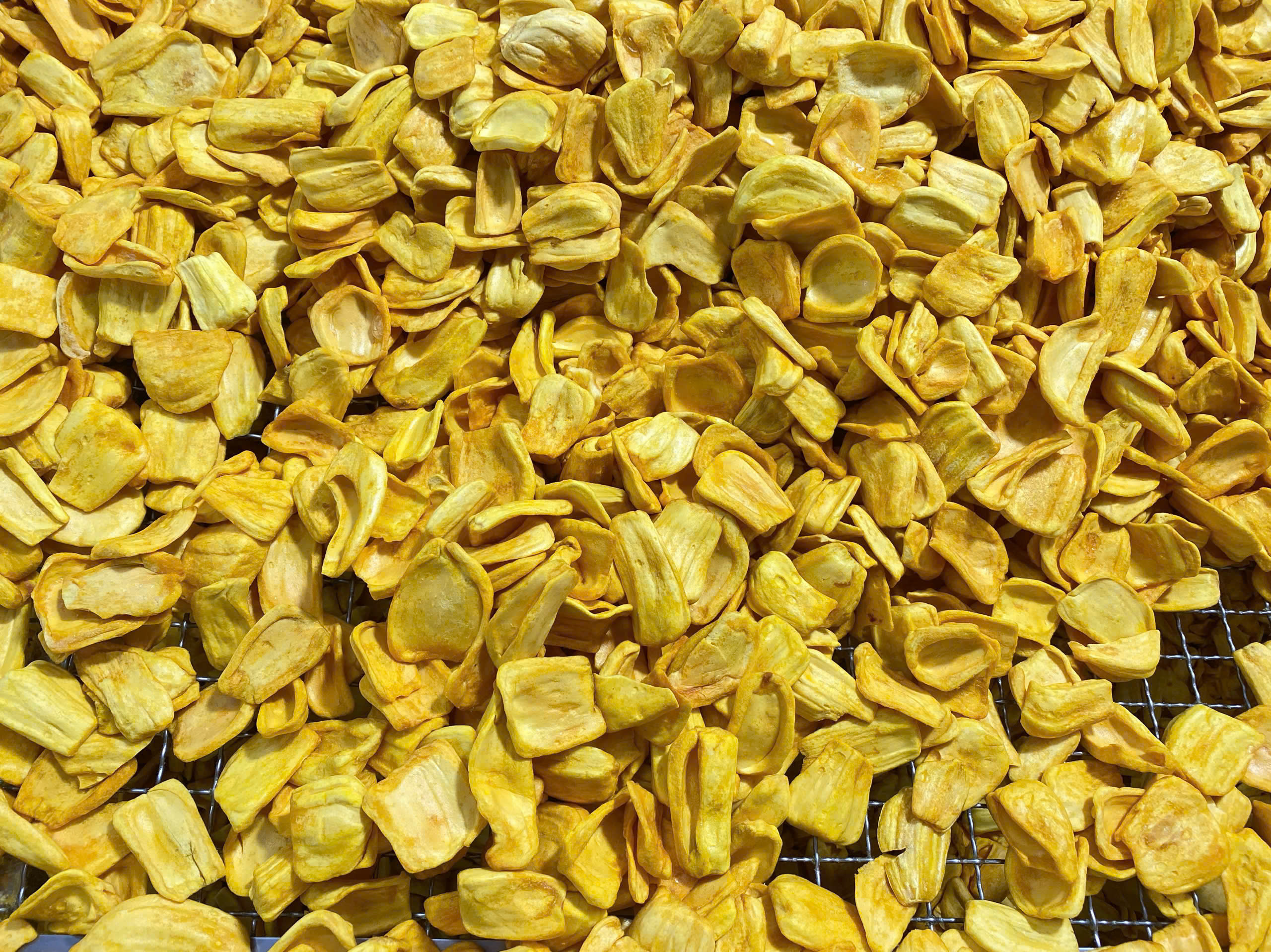
Texture is one of the key sensory characteristics of crispy jackfruit chips.
Consumers generally expect the product to provide a dry, crisp or crunchy bite.
However, crispness can change if the chips absorb moisture from the surrounding environment.
This may happen because of:
As moisture enters the product, the eating texture may gradually become less crisp.
That is why moisture management is closely connected to jackfruit chips shelf life.
Moisture content and water activity are related, but they are not the same thing.
Moisture content refers to the amount of water present in the product.
For jackfruit chips, the drying or frying process removes a significant portion of the fruit’s original moisture.
The final moisture level can influence:
However, moisture percentage alone does not explain everything.
Water activity, often abbreviated as aw, describes how available water is within the food system.
Two products can have similar moisture content but behave differently depending on how water is bound within the product.
For this reason, water activity can be an important parameter when manufacturers evaluate shelf stability.
However, there is no universal aw value that should be quoted for every jackfruit chip product without supporting product documentation.
The actual target should come from the manufacturer’s technical specification and validation data.
A crisp snack generally performs best when moisture movement is controlled.
When the product absorbs water from humid air, its structure can soften.
That means water activity can influence how the product interacts with the surrounding environment.
For manufacturers, this creates an important relationship:
product condition + packaging barrier + storage humidity = texture stability
A good package cannot fully compensate for a poorly processed product.
Likewise, a well-processed chip may still lose crispness if the package does not provide sufficient protection.
For jackfruit chips shelf life, packaging is not just a marketing surface.
It is part of the preservation system.
A suitable package may need to provide protection against:
The required barrier depends on the actual product.
Different packaging structures can perform differently under the same storage conditions.
For this reason, manufacturers should validate the final product together with the final package.
Moisture barrier is especially important for crisp fruit snacks.
If water vapor enters the package, the chips may absorb moisture over time.
This may lead to:
Packaging materials should therefore be selected according to the intended product and distribution conditions.
Oxygen control may also matter depending on:
The appropriate oxygen barrier should be determined through product and packaging evaluation.
Again, there is no single film structure that is automatically correct for every jackfruit chip application.
Even a high-barrier packaging material cannot protect the product properly if the seal is weak.
Seal defects may allow:
to enter the package.
Manufacturers should therefore evaluate:
during production.
For B2B buyers, packaging quality should be reviewed together with the product itself.
There is no single answer to how long do jackfruit chips last.
The actual shelf life depends on factors such as:
The manufacturer should establish the shelf life based on the actual product and packaging configuration.
A shelf-life claim should not be copied from another product simply because both are called jackfruit chips.
Storage environment is another important part of product stability.
Excessive heat may accelerate changes in:
For this reason, jackfruit chips should be stored according to the manufacturer’s recommended conditions.
General good practice may include keeping sealed packages:
The actual storage instructions should follow the product label and specification.
For dried jackfruit storage, humidity deserves particular attention.
Jackfruit chips are dry and can absorb moisture from the surrounding air if packaging protection is compromised.
This is especially relevant in:
For importers and distributors, warehouse conditions can therefore influence the final consumer experience.
Once the package is opened, the product is exposed to the surrounding air.
The speed of texture change depends on factors such as:
There is no universal number of days that opened jackfruit chips will remain crisp.
Users should follow the package instructions and reseal the product where possible.
For more detailed guidance, this topic can link internally to:
“Keep Jackfruit Chips Crispy After Opening.”
Manufacturers also need to control moisture during production.
If the product leaves the production line with unsuitable moisture characteristics, packaging alone may not create the intended texture stability.
This is why moisture control starts before packing.
Potential control points may include:
For a deeper discussion, readers can be directed to:
“Jackfruit Chips Moisture Level.”
This avoids repeating the same technical content in multiple articles.
After processing, the product should reach an appropriate condition before packing.
If a warm product is sealed too early under unsuitable conditions, moisture behavior inside the package may be affected.
Commercial processors should establish packaging procedures according to their actual equipment and product.
No universal cooling time should be applied without process validation.
Large family packs and single-serve packs create different usage conditions.
A single-serve pouch may be opened and consumed in one occasion.
A larger bag may be opened several times.
This difference can affect post-opening exposure to humidity.
However, smaller packaging does not automatically guarantee:
The full packaging system still needs to be tested.
Primary packaging protects the product directly, but secondary packaging also matters during export.
Cartons help protect pouches from:
For international shipping, buyers should consider:
Damage during logistics can compromise the primary package even if the original seal was correct.
A commercial shelf-life claim should be supported by actual testing.
Manufacturers may evaluate products over time for characteristics such as:
The exact testing protocol depends on the product and quality system.
For B2B buyers, this is more reliable than assuming a standard shelf life based on product category alone.
Crispness is partly sensory.
Different buyers may describe the same chip as:
For this reason, approved samples can be useful.
The buyer and supplier can align expectations regarding:
This helps reduce misunderstandings later.
For international trade, written specifications may not fully describe sensory quality.
An approved sample can complement technical documentation.
A useful approval process may include:
Specification + Approved Sample + Packaging Confirmation
This creates clearer expectations between supplier and buyer.
When evaluating jackfruit chips shelf life, buyers can ask:
The goal is not to demand a universal answer.
It is to understand how the actual product is controlled.
An expiry or best-before date provides useful information, but buyers should also understand the system behind it.
The date is meaningful only when:
If any of these conditions change, product quality may also change.
Jackfruit chips are dry products, but dry foods can still change during storage.
Possible changes may include:
Drying reduces moisture but does not remove the need for proper packaging and storage.
This distinction is important for technical buyers.
Moisture content tells you how much water is present.
Water activity provides information about the availability of that water within the product system.
Both can be useful, but they answer different questions.
Technical decisions should therefore rely on actual product documentation rather than simplified assumptions.
Manufacturers and buyers can think about jackfruit chips shelf life as four connected elements:
Product → Water Activity → Packaging → Storage
If one part of the system is weak, the final texture may be affected.
For example:
Good product + poor seal = potential moisture exposure
or:
Good package + unsuitable product moisture = texture risk
Shelf-life management therefore requires a system approach.
This topic works particularly well as an infographic.
What Keeps Jackfruit Chips Crisp?
1. Moisture
Control moisture during processing.
2. Water Activity
Evaluate the product’s actual stability.
3. Packaging
Use appropriate barrier and sealing.
4. Storage
Keep packages dry and properly protected.
Shelf life depends on the complete product + packaging system.
This gives social-media audiences the core information without requiring them to read the full technical article.
Another option is a short video.
Open a sealed bag of jackfruit chips.
Text:
“What keeps jackfruit chips crisp?”
Show a close-up of the chip texture.
Text:
“1. Moisture Control”
Show packaging.
Text:
“2. Packaging Barrier”
Show the seal.
Text:
“3. Seal Integrity”
Show storage cartons.
Text:
“4. Proper Storage”
Show the finished product.
Text:
“Shelf life is a complete system.”
This format is suitable for:
There is no universal duration. Shelf life depends on the actual product, processing, packaging, sealing, and storage conditions.
Moisture exposure is one important factor. Packaging damage, humidity, and storage conditions can also influence texture.
No. Moisture content measures the amount of water, while water activity describes how available water is within the food system.
Not automatically. Packaging size is only one factor. Film barrier, seal integrity, processing, and storage also matter.
Follow the instructions on the actual product packaging. In general, sealed products should be kept in appropriate dry storage conditions and protected from excessive heat and moisture.
Jackfruit chips shelf life cannot be determined by one factor alone.
Crispness and product stability depend on the interaction between:
moisture + water activity + packaging barrier + seal integrity + storage.
This is why the question “how long do jackfruit chips last?” should always be answered using the technical information for the actual product.
For manufacturers and B2B buyers, the most reliable approach is:
Control the product → Select appropriate packaging → Validate the final pack → Follow storage requirements.
For additional reading, link this article to:
“Keep Jackfruit Chips Crispy After Opening”
and:
“Jackfruit Chips Moisture Level.”
These supporting articles can cover post-opening storage and moisture management in greater detail without repeating the same information.
Abimex Group supplies Vietnamese crispy jackfruit chips for international importers, distributors, retailers, foodservice buyers, and private-label projects.
Buyers can contact us to discuss:
Contact Abimex Group to discuss Vietnamese jackfruit chips for your retail, distribution, or private-label snack project.